
Section: IRA & 401(k) Real Estate Investing
Yes, you can buy a rental property with your IRA. Houses, duplexes, condos, raw land, tax deed properties. The IRS allows it.
What the IRS also allows is for you to lose the entire tax benefit of that account in one afternoon if you break a rule most people never hear about until it’s too late.
I’ve spent 23+ years in real estate, and self-directed IRAs are one of the strongest tools an investor can use. They’re also one of the easiest to mess up. Let me walk you through how it works, where the landmines are, and then show you the actual numbers on one of my deals.
First, what a self-directed IRA actually is
Your regular IRA at a big brokerage is set up for stocks, bonds, mutual funds, and ETFs. That’s not a law. It’s just what that company decided to offer.
A self-directed IRA is held by a custodian that allows alternative assets, including real estate. You still have a regular IRA, Traditional or Roth. The account just has a different holder, and you decide what goes in it.
Two things people get wrong right away:
• The custodian doesn’t give advice. They hold the account, process the paperwork, and report to the IRS. They don’t check your deal, your numbers, or the person selling you the property.
• You don’t own the property. Your IRA does. The title reads something like “[Custodian name] FBO [Your Name] IRA.” That one detail drives every rule below.
The one rule that drives everything: no self-dealing
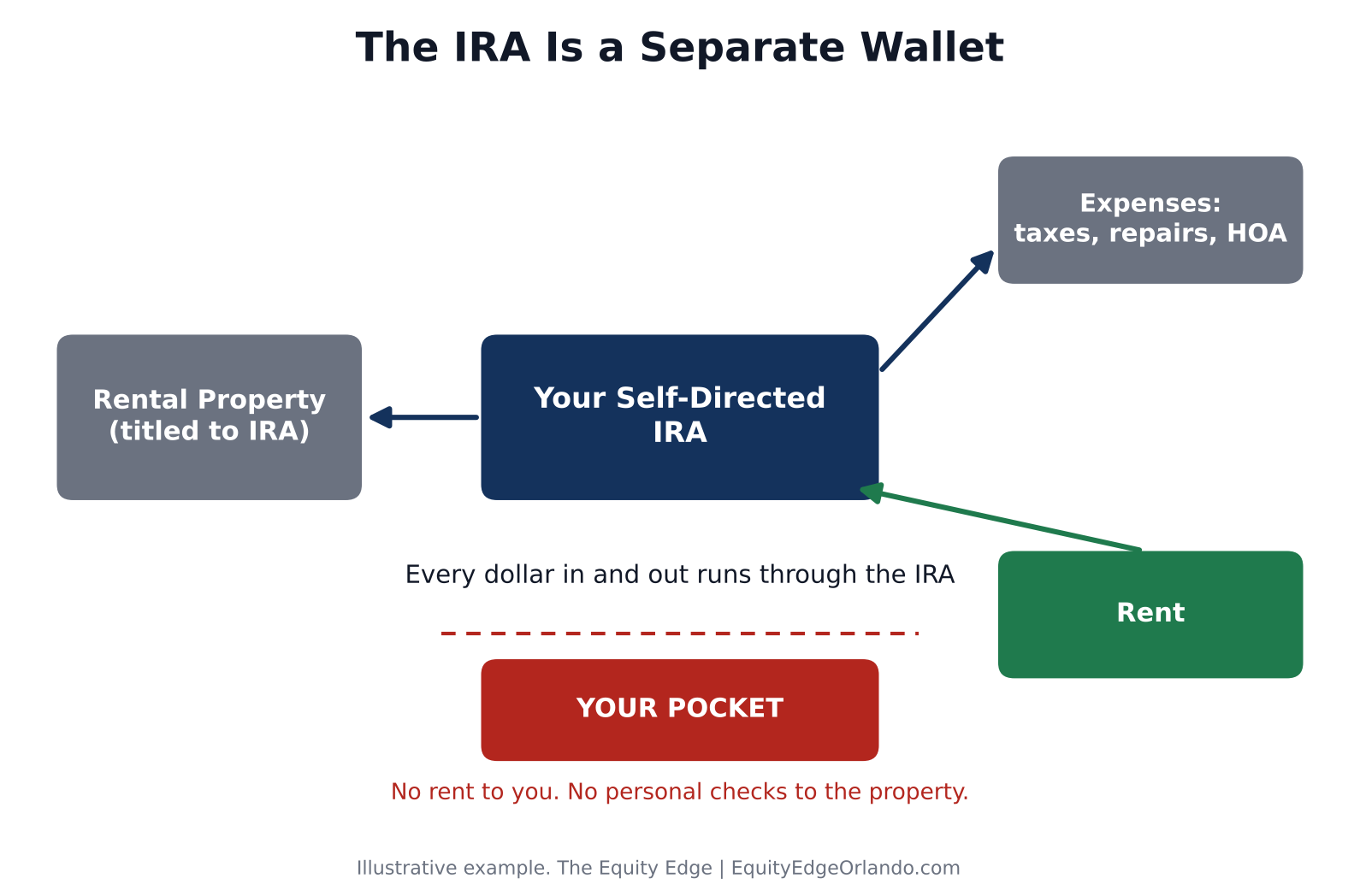
The IRS calls it a prohibited transaction. Here’s the plain-English version: your IRA has to be a separate wallet, and you can’t mix it with your own pocket.
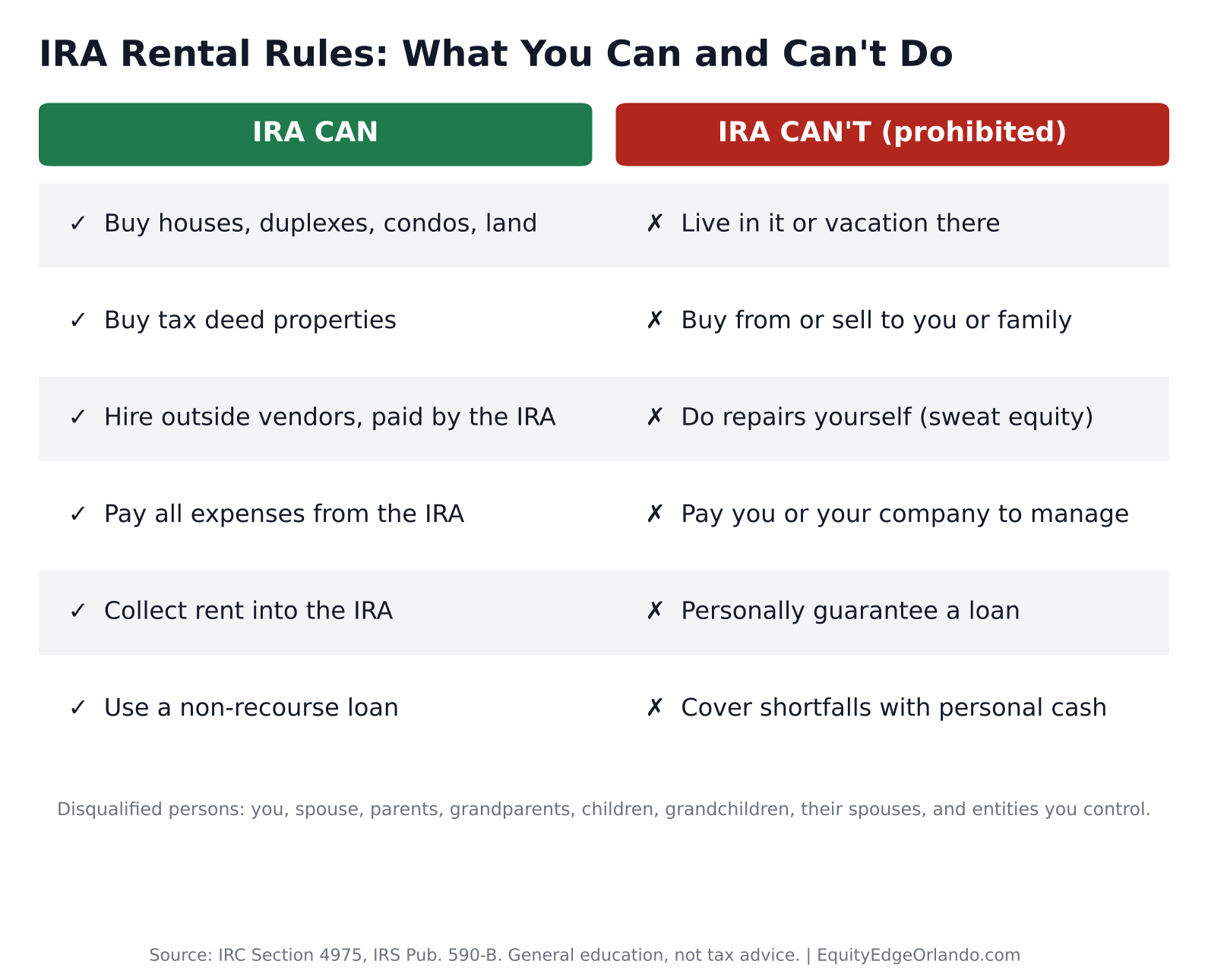
The IRS defines a group of people called disqualified persons. That’s you, your spouse, your parents and grandparents, your children and grandchildren and their spouses, and any business you control. Your IRA can’t do business with any of them.
Here’s what that looks like in real life:
• You can’t live in the property. Not full time, not for a weekend. Not “just until the tenant moves in.”
• You can’t buy it from, or sell it to, yourself or a family member. Your IRA can’t buy your mother’s house. It can’t buy a rental from your own LLC.
• You can’t do the work yourself. This is the one that catches people. Say you’re a handyman or a contractor, and the roof needs $2,000 of labor. You can’t swing the hammer and “save the IRA some money.” That’s sweat equity, and it counts as a prohibited transaction. Your IRA has to hire someone else.
• You can’t pay yourself to manage it. No management fee to you, your spouse, or your company.
• You can’t personally guarantee a loan. More on that below.
• You can’t use your own money to cover a shortfall. If the roof leaks and the IRA is out of cash, you can’t write a personal check for the repair.
Notice that none of this has anything to do with whether the deal is a good deal. A great deal can still be a prohibited transaction.
What happens if you break the rule
This is the part that should make you slow down.
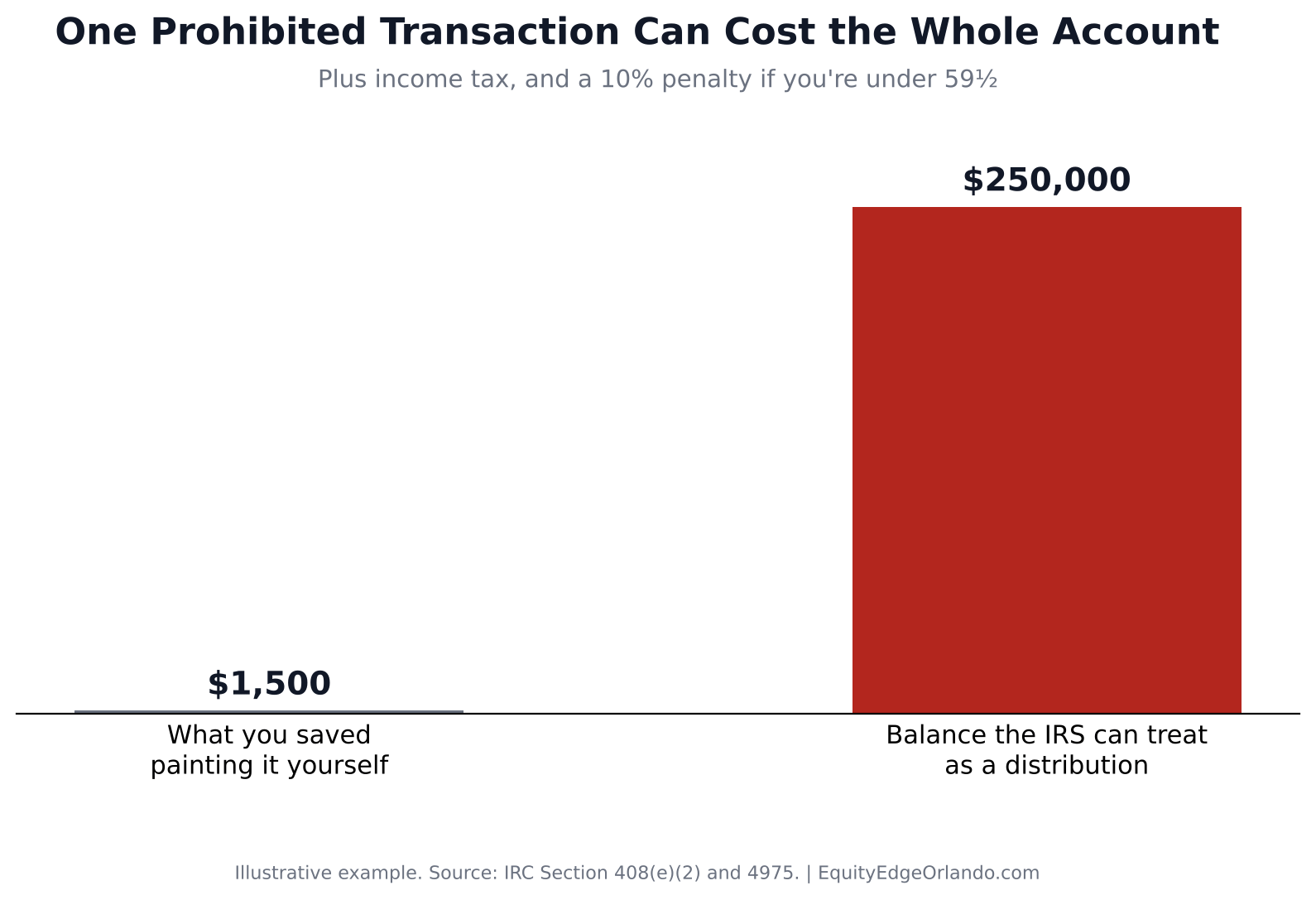
If the IRA owner takes part in a prohibited transaction, the account stops being an IRA as of January 1 of that year. The whole balance is treated as if you took it out. You owe income tax on all of it, and if you’re under 59½, you can also owe the 10% early withdrawal penalty.
Picture an IRA worth $250,000. You paint the unit yourself on a Saturday to save $1,500. Come tax time, the IRS can treat the entire $250,000 as a distribution. The $1,500 you saved cost you the account.
That’s the downside. It’s also completely avoidable.
How the money works
Everything runs through the IRA. No exceptions.
• Money in: Purchase price, closing costs, repairs, insurance, property taxes, HOA dues, and code fines all come from the IRA.
• Money out: Every dollar of rent goes back into the IRA. Not to your checking account. Not to your Venmo.
In Florida, this matters more than people think. HOA assessments, special assessments, and code enforcement liens show up on a schedule you don’t control. If the IRA doesn’t have a cash cushion, you can end up with a property that needs money the account doesn’t have, and you can’t fix it with your personal funds.
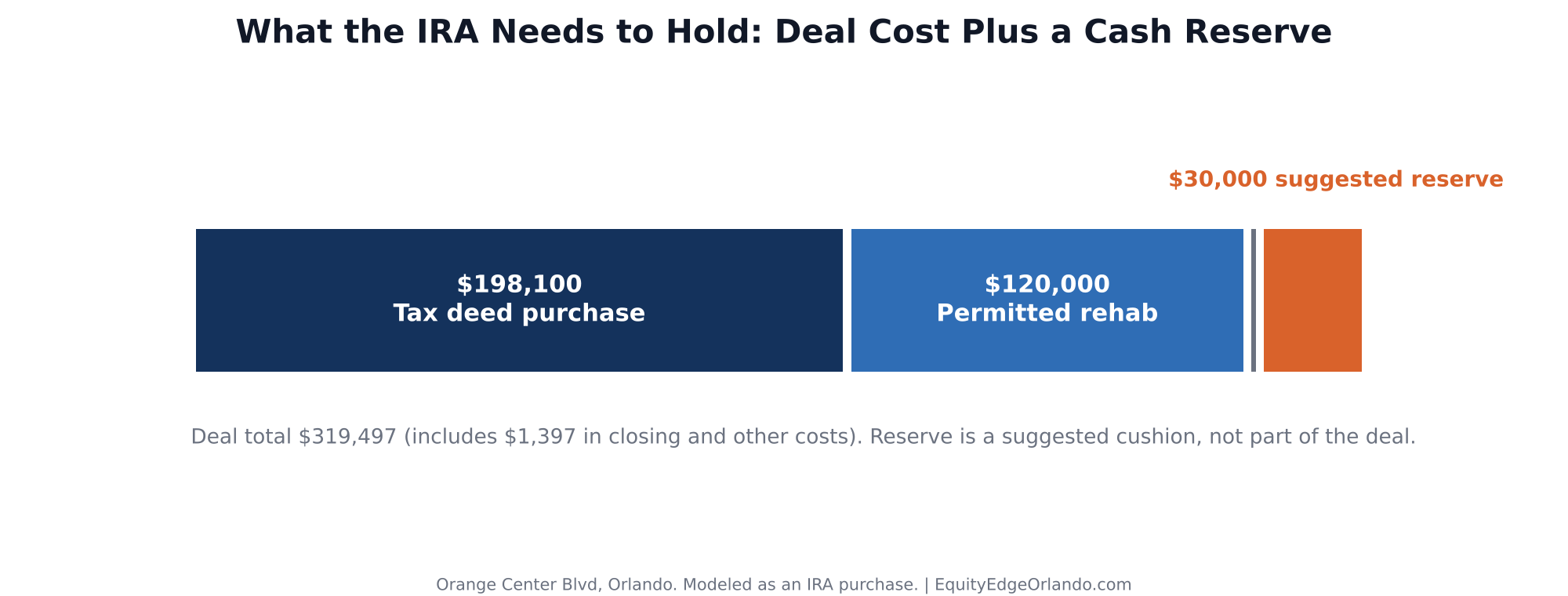
Rule of thumb: keep a cash reserve inside the IRA after you buy. Buying a property with every dollar in the account is how deals get stuck. On a deal like the Orange Center Blvd house below, where the all-in cost was $319,497, I’d want the IRA holding closer to $350,000 so there’s a cushion for taxes, insurance, repairs, and vacancy.
Can you use a loan? Yes, but it’s different
You can use leverage in an IRA, but the rules change.
• It has to be a non-recourse loan. That means if the loan defaults, the lender can only go after the property. They can’t go after you or your IRA’s other assets. You can’t sign personally, and these loans usually cost more and need bigger down payments than a standard mortgage.
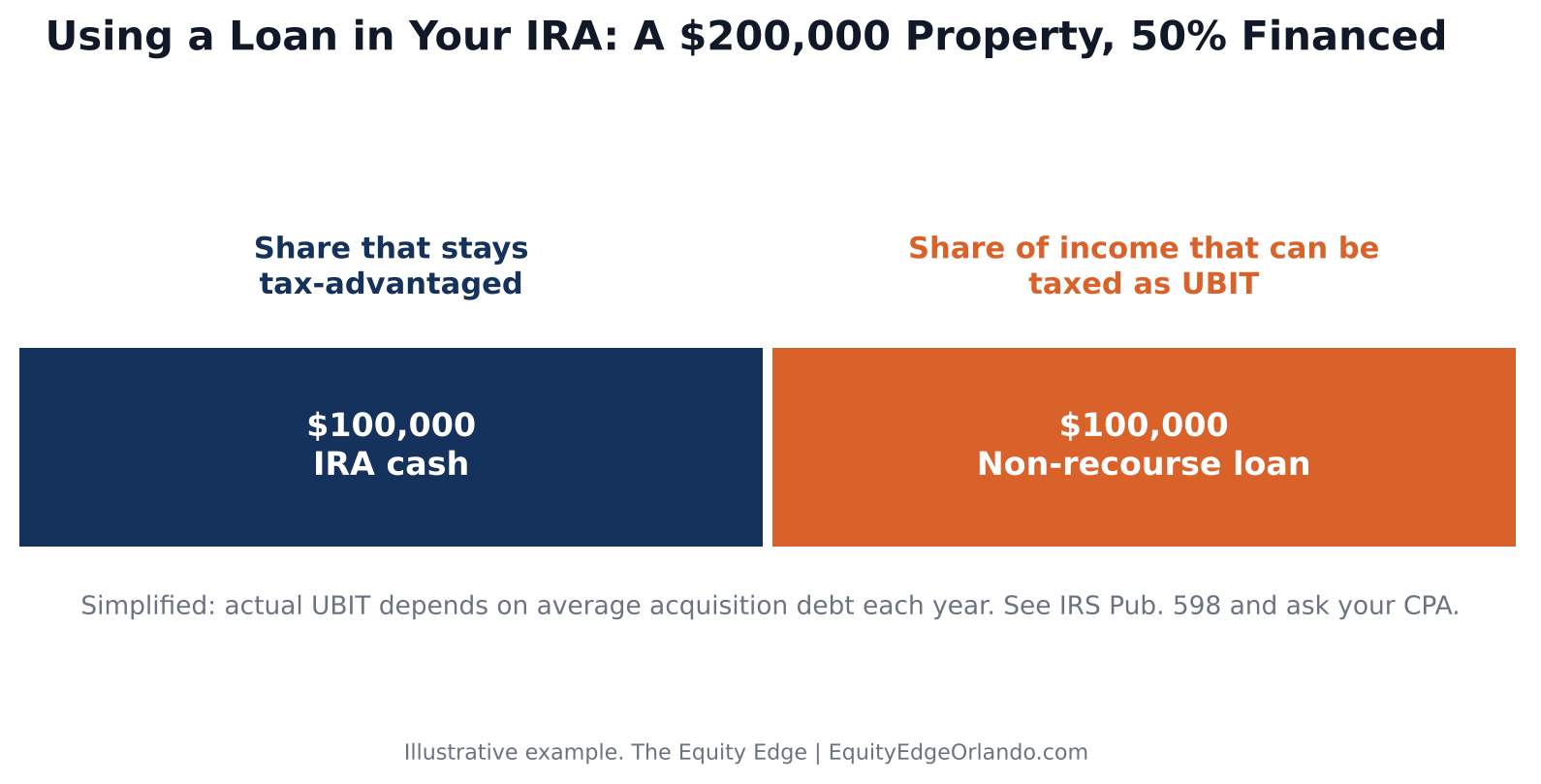
• Debt-financed income can be taxed. When your IRA uses borrowed money, the share of the income tied to that debt can trigger something called UBIT (Unrelated Business Income Tax), also known as UDFI. A simple version: if half the property is paid for with a loan, roughly half the net income can be taxed. The IRS covers this in Publication 598.
Is leverage still worth it? Sometimes. But run the numbers with the tax included, and talk to a CPA who understands this before you sign anything. A solo 401(k) is generally treated differently on this, which is one reason some investors with their own business prefer it. That’s a separate conversation, and I’ll cover it in a future issue.
A real example: the Orange Center Blvd deal inside an IRA
Let me show you what this looks like with one of my own deals, using the real numbers.
The property is on Orange Center Blvd in Orlando, in the Cooks Manor area. I bought it at the Orange County tax deed sale in November 2025 for $198,100. I put $120,000 into a full permitted gut rehab: new roof, electrical, plumbing, HVAC, kitchen, baths, windows, and doors, built to 2026 code. It’s leased at $2,600 a month on a 2-year lease. All-in, with closing and other costs, I have $319,497 in it, and it’s worth about $400,000 today.
Now picture the same deal with an IRA as the buyer instead of me personally. Same price, same rehab, same lease. The IRA pays cash, hires every vendor, and collects every dollar of rent.
Assumptions for the 30-year model:
• All cash. No loan, so no UBIT.
• Rent, property value, property taxes, and insurance all grow 3% a year. That’s roughly inflation, which keeps this conservative.
• Management stays at 10% of rent. Property tax starts at $3,198 a year and insurance at $2,300.
• Each year’s net income is invested in an index fund inside the IRA at 10% a year.
• No vacancy or major repair costs are modeled. I’ll show you what happens when I trim the rent below.
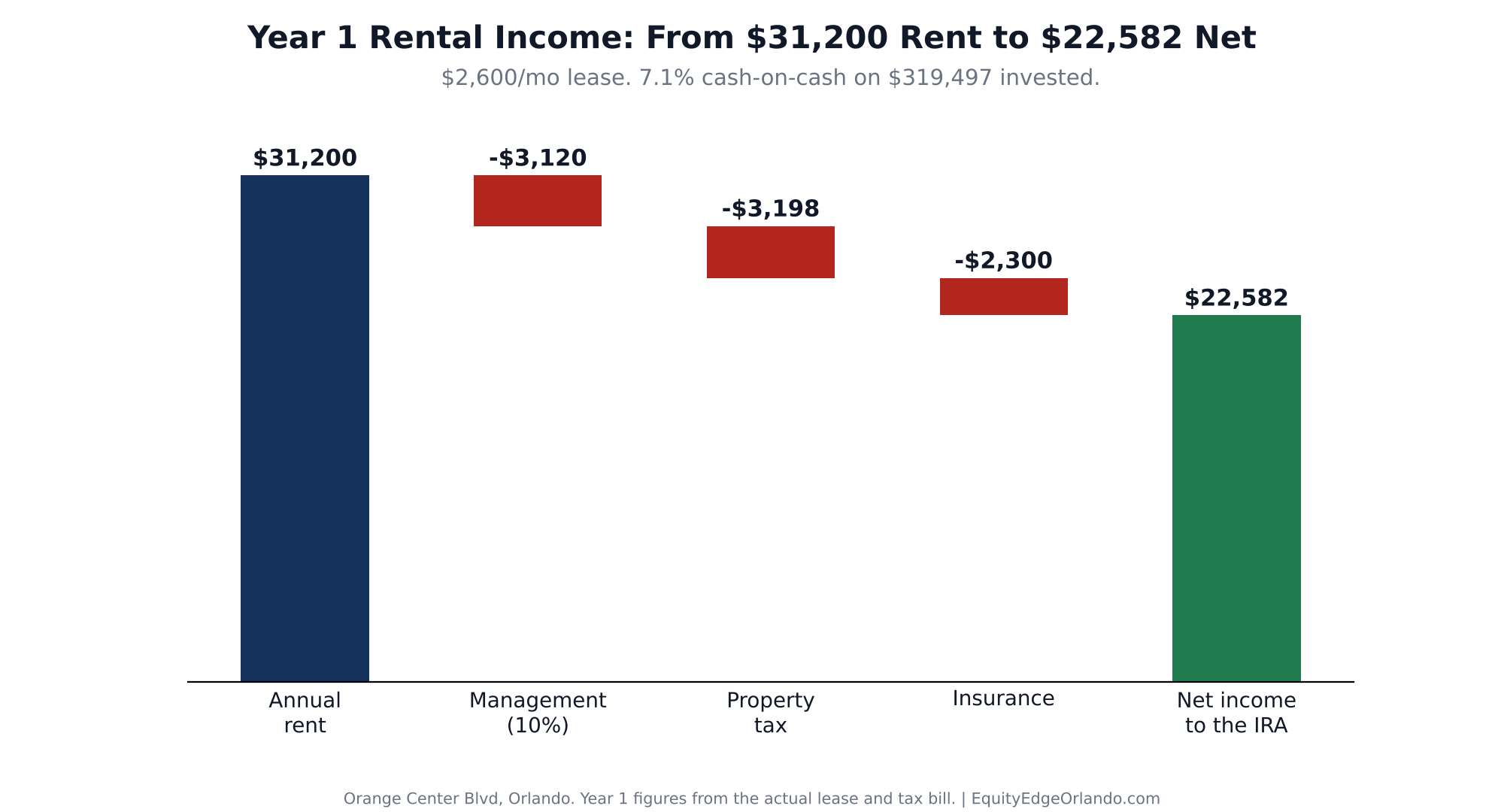
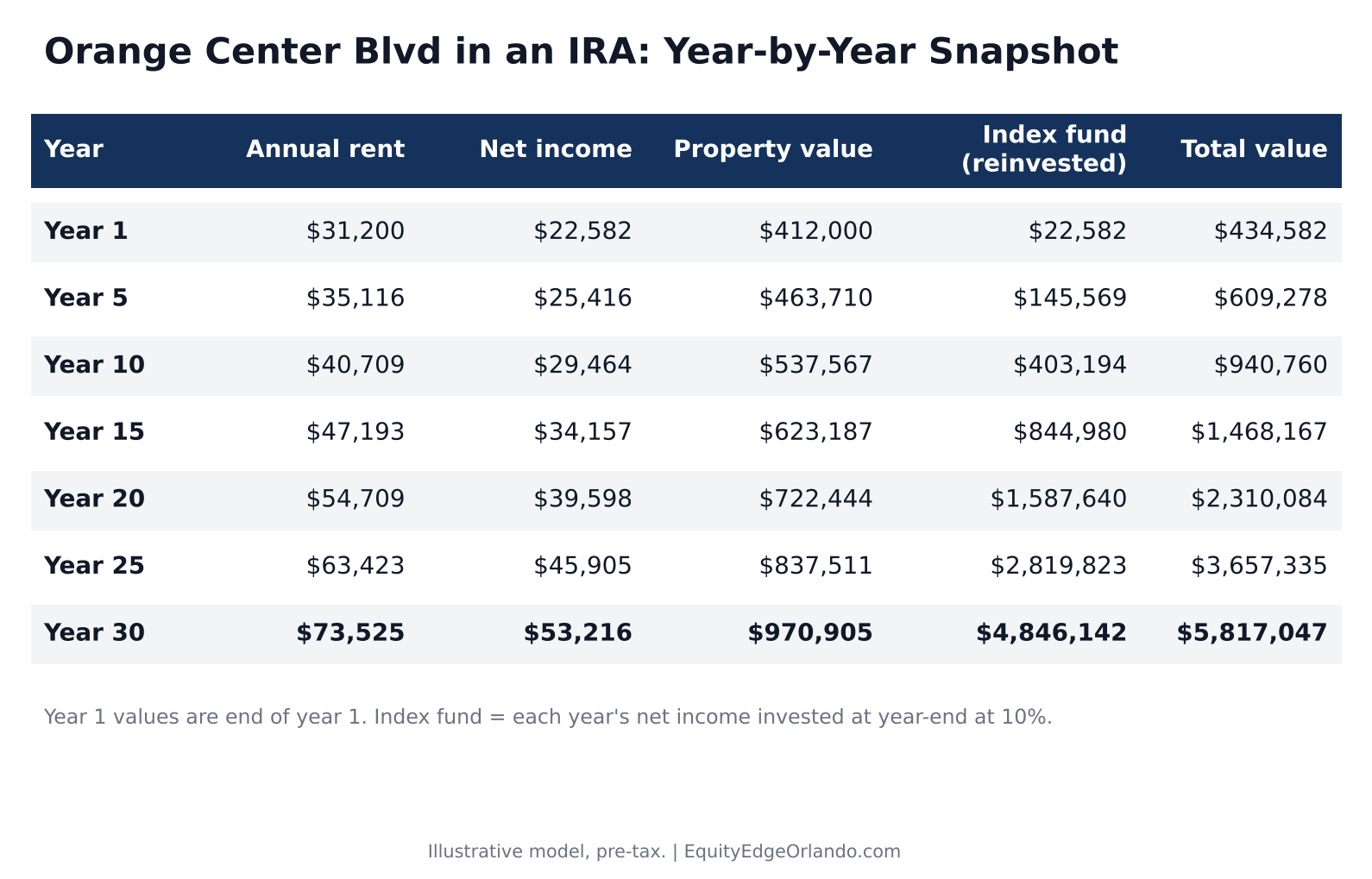
Year 1. Rent is $31,200. After management, property tax, and insurance, the IRA nets $22,582. That’s a 7.1% cash-on-cash return on the $319,497 invested.
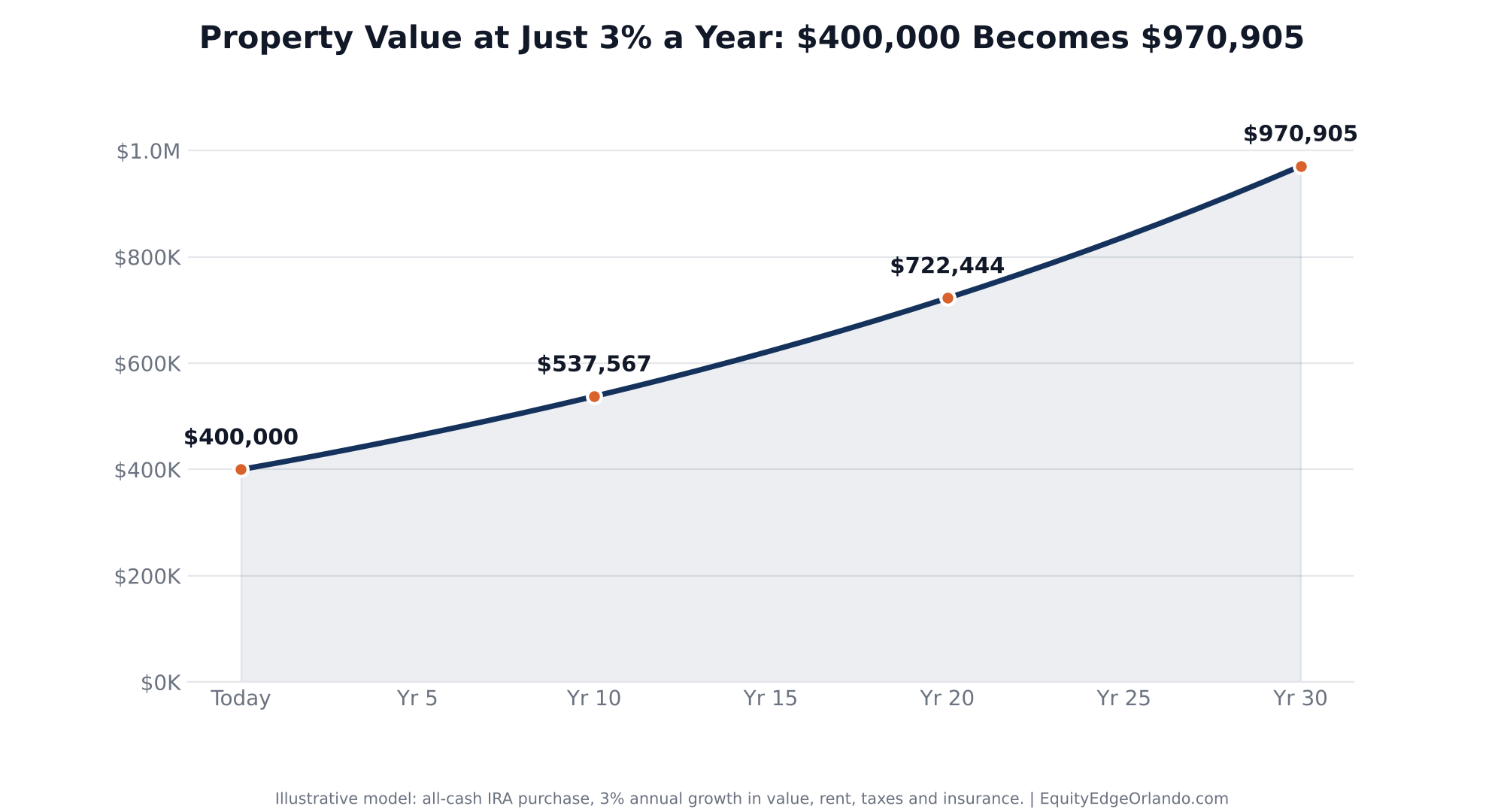
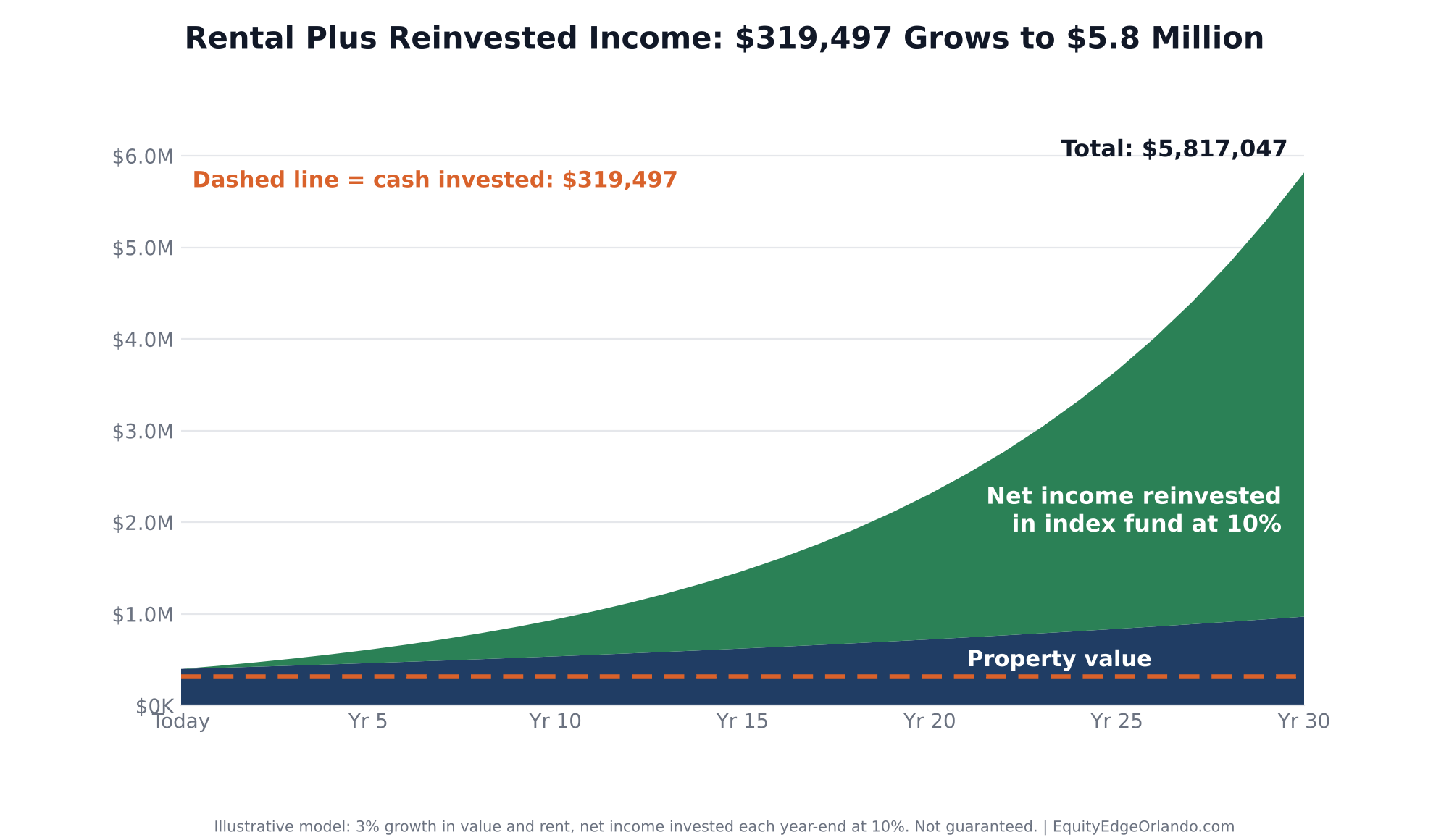
The property. Growing at just 3% a year, a $400,000 property is worth $537,567 in year 10, $722,444 in year 20, and $970,905 in year 30.
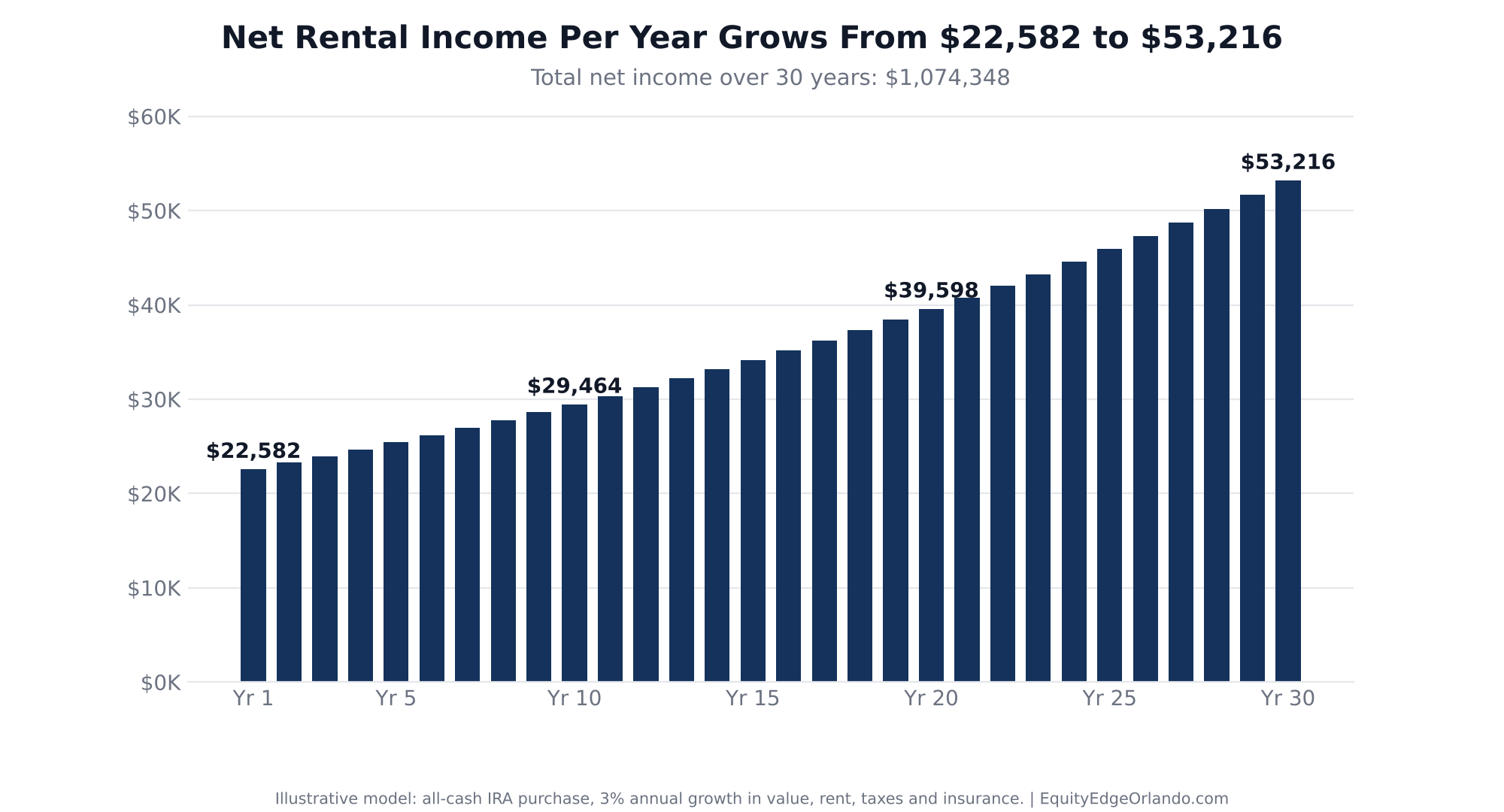
The income. Rent grows with the economy, so net income grows too. It starts at $22,582 and reaches $53,216 a year by year 30. Add it all up and the rental throws off $1,074,348 in net income over 30 years.
The reinvestment. Here’s where it gets interesting. If that net income just sits in the IRA as cash, you end up with the property plus about $1.07 million: $2,045,253 total. That’s 6.4x your money.
But if each year’s net income gets invested in an index fund inside the IRA at 10%, that same cash flow grows to $4,846,142. Add the property, and the IRA holds $5,817,047. That’s 18.2x the $319,497 you put in, or about 10.2% a year over 30 years.

The honest read on these numbers
I’d rather you hear this from me than find it out later.
• The 10% is an assumption, not a promise. It’s close to the long-run average for the S&P 500, but some decades have been far worse. Run the same model at 7% and the IRA still reaches $3,898,093.
• Today’s dollars matter. $5.8 million in 30 years is about $2.4 million in today’s money at 3% inflation. Still a big number. Just keep it honest.
• The rental barely beats the index in this scenario. If you put the same $319,497 straight into an index fund at 10%, you’d end up with $5,575,032. The rental plus reinvested income came out about $242,000 ahead. At a 7% index return, the gap widens a lot: $3,898,093 for the rental plan versus $2,432,093 for the index alone. The reason is that rent growth and appreciation don’t depend on the stock market. The point of owning real estate in an IRA isn’t to beat the index. It’s to own a hard asset you control, diversify, and create value the market didn’t give you.
• You created value on day one. This house cost $319,497 all in and is worth about $400,000. That’s roughly $80,503 in equity from buying a distressed tax deed and fixing it right. That’s the part an index fund can’t give you.
• Trim the rent and it still works. Knock 10% off the rent for vacancy and surprises, and the 10% scenario still ends at about $5,214,445, or 16.3x.
• Selling costs. If you sold the property in year 30 and paid 7% in costs, the total would be about $5,749,084.
• Taxes. In a Roth IRA, growth and qualified withdrawals can be tax-free. In a Traditional IRA, you pay ordinary income tax when you take money out. That’s one more reason to talk to a CPA before you pick the account type.
Where people get hurt (and how to avoid it)
1. They run out of cash. The property needs a repair, the IRA is empty, and the owner can’t put in personal money. Fix: reserve cash inside the account before you buy.
2. They do “a little” of the work. Painting, cleaning, a quick fix, picking up the rent check at the property. Fix: every task goes to an outside vendor, paid from the IRA.
3. They deal with the wrong person. A cousin’s flip, a friend’s partner, an LLC they own part of. Fix: before you do any deal, confirm the other side isn’t a disqualified person.
4. They have a timing problem on auctions. Tax deed sales require funds quickly after the bid. If your IRA isn’t set up and funded, the wire won’t happen in time. Fix: open the account and get the funds in place weeks before the auction, and ask your custodian how fast they can wire.
5. They trust the custodian to vet the deal. They won’t. If someone pitches you a “turnkey” property or a partnership, you do the due diligence. The custodian just processes it.
6. They forget about required distributions. Traditional IRAs eventually require minimum distributions. If the account is all real estate with no cash, you may have to sell a property or take a piece of it out just to satisfy the rule. Plan for that early.
Do you need a special account?
Yes. A custodian that holds real estate is required. A lot of the big brokerages won’t do it. Before you open an account, ask:
• What are the annual fees, and are they flat or based on asset value?
• How long does it take to wire funds or sign closing documents?
• Do they handle non-recourse loans?
• Can the account also hold index funds, so rental income can be reinvested without opening a second account?
• Will they work with my title company and closing attorney?
If you already have money in a 401(k) or another IRA, you can usually move it into a self-directed IRA with a direct trustee-to-trustee transfer. Don’t take a check made out to yourself. A direct transfer avoids timing and tax problems.
Is it worth it?
For the right investor, yes. Rental income that’s tax-deferred or tax-free is powerful. Over 10 or 20 years, that difference adds up fast.
But it isn’t for everyone. If you want to be hands-on, do your own repairs, and use your own cash as a safety net, an IRA will frustrate you. In that case, you may be better off holding rentals personally or through an LLC.
It works best for people who:
• Have real money already sitting in an IRA or old 401(k)
• Want passive, hands-off rentals
• Will hire out every task and keep a cash cushion
• Are patient and don’t need the cash flow right now
Your next step
Before you move a dollar, do these three things:
1. Check your account types and balances. Find out what you have, Traditional or Roth, and how much.
2. Interview two custodians. Get fees and wire times in writing.
3. Write down the deal rules. Cash reserve, outside vendors only, and no deals with family or entities you control. Then stick to them.
Thinking about buying a rental or a tax deed property with your IRA? Reach out. I’ll tell you straight what I’d check first.
This is general education, not tax or legal advice. The 30-year figures are an illustrative model, not a forecast or a guarantee, and every account is different. Confirm the details with your custodian and a CPA before you act. Sources: [IRS Publication 590-B](https://www.irs.gov/publications/p590b), [IRS Publication 598](https://www.irs.gov/publications/p598), and [IRC Section 4975](https://www.law.cornell.edu/uscode/text/26/4975).
Connect With Me
Yogi Ganeshram | Real Estate Agent, eXp Realty LLC
Phone: (321) 217-4220
Email: yogi@orlandosgreatesthomes.com
Website: EquityEdgeOrlando.com
Instagram: @yogisequityedge
TikTok: @yogisequityedge
Facebook: facebook.com/yganeshram
LinkedIn: linkedin.com/in/yganeshram
YouTube: @YogisEquityEdge
Pinterest: @yoganeshram