
A house costs $190,000. The full renovation budget is $110,000. If it sells for $400,000, the first two numbers leave a $100,000 price spread.
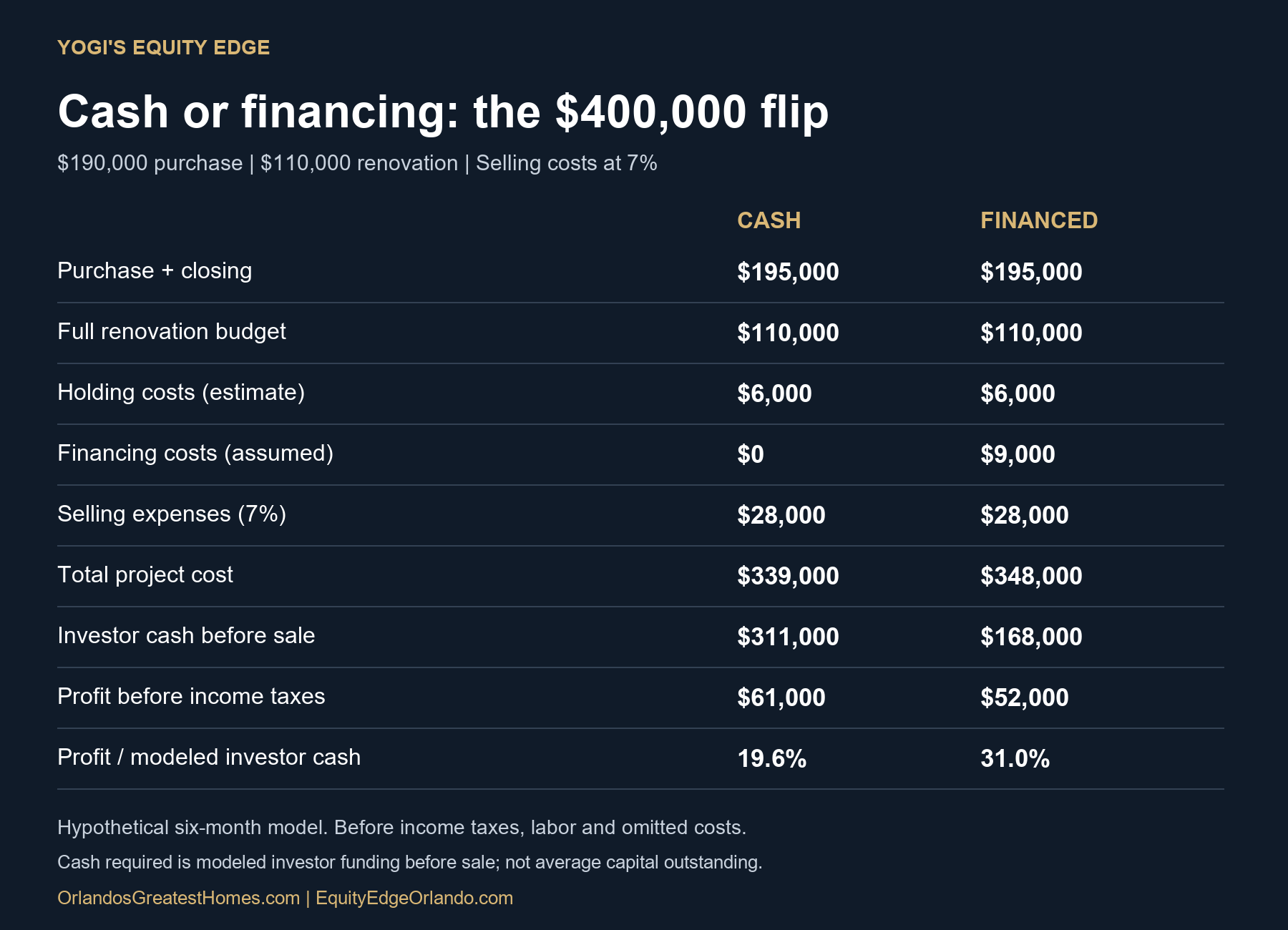
But that is before closing costs, carrying costs, selling expenses, and financing. In this worked example, the cash buyer keeps $61,000. The financed buyer keeps $52,000 while committing $143,000 less of their own money.
Would you pay $9,000 to keep that extra cash available? The answer starts with your reserves, the loan terms, and how much room the deal has if something goes wrong.
This is a hypothetical teaching example using a $190,000 purchase, $110,000 renovation and $400,000 resale. It is not a completed deal, current listing, appraisal, loan quote or promise of returns.
Finding the purchase is the first job
For this article, picture the cash scenario as a distressed home purchased at a foreclosure auction. Picture the financed scenario as a negotiated off-market opportunity, with enough time for the lender, title work and closing requirements. These are the acquisition routes being illustrated, rather than a typical retail purchase. The same purchase, renovation and resale assumptions are held constant to compare the funding economics.
A $190,000 purchase with a $110,000 renovation needs a reason for the discount and a clear understanding of the work. The task is to find an opportunity, investigate it, and decide whether the price leaves enough room for the condition, costs and risks.
That is where my work with buyers and investors comes in: finding distressed and off-market homes, evaluating the numbers, and helping clients navigate the research and acquisition process. The knowledge needed before bidding can matter as much as the renovation budget afterward.
My focus here is finding and evaluating the distressed opportunity before committing money. Foreclosure auctions, tax deed auctions and negotiated off-market purchases have different procedures. Cash purchases are also possible in traditional sales, and financing is not limited to off-market homes. Neither the acquisition route nor the payment method guarantees this purchase price or profit.
For Orange County tax deed sales, the Comptroller warns that properties are sold as-is, buyer beware, and may have additional taxes or liens. Before bidding, investigate the title, liens, possession, condition, access and the exit you can actually execute. Bring in title and legal professionals where needed.
Funding must be ready before the bid. Orange County’s tax deed guidance requires the balance within 24 hours of the winning auction. Do not assume an ordinary purchase mortgage can close in that window. The financing column below is a funding illustration, not a promise that a lender will finance a particular auction purchase. Confirm the sale’s rules, lender eligibility and disbursement timing first.
The cost allowances also need to cover applicable auction charges and documentary stamps. Title work, legal work, possession costs, or financing after acquisition could add expenses beyond this model. Update the budget before treating its profit as usable.
Six months is the budget, not a guarantee
The $6,000 holding-cost allowance is an unverified six-month estimate, not a mortgage payment or an actual property quote. It assumes $1,000 per month for property taxes, insurance, utilities, maintenance and any applicable association charges. A cash buyer still pays those ownership expenses. Replace this placeholder with the actual property budget; if it is lower or higher, modeled profit changes dollar for dollar. Loan interest is separate and is included only in the financed column.
The projected $61,000 cash profit and $52,000 financed profit assume the property is acquired, renovated and resold within six months. If the project runs longer, holding costs continue and profit falls, even if the final sale price stays at $400,000.
Taxes, insurance, utilities and other property costs continue for both buyers. Borrowers also need to account for continuing interest and any lender extension charges. Paying cash removes loan interest, not the cost of owning an unfinished or unsold property.
Using the delay assumptions in this example, each month beyond month six adds $1,000 for the cash buyer or $2,500 for the financed buyer. Those figures are illustrations, not quotes or guaranteed monthly costs.
Sold by month six: $61,000 cash profit / $52,000 financed profit.
Sold in month eight: $59,000 cash / $47,000 financed.
Sold in month nine: $58,000 cash / $44,500 financed.
Sold in month twelve: $55,000 cash / $37,000 financed.
These timing scenarios keep the sale price and all other costs unchanged, assume the loan can remain outstanding on those terms, and exclude extension fees, penalties and additional repairs. Confirm the lender’s maturity and extension terms; continued financing is not automatic. Delayed possession, permits, contractor schedules and a slower resale can all extend the calendar.
Keep the house the same. Change the funding.
Assume six months from acquisition through resale. Both buyers pay the same price, complete the same renovation and sell for $400,000.
Purchase: $190,000
Full renovation budget: $110,000
Purchase closing costs: $5,000
Taxes, insurance, utilities and other property carrying costs: $6,000
Selling expenses at 7% of the $400,000 sale price: $28,000
The modeled project costs total $339,000 before financing. The $110,000 is treated as the entire renovation allowance, with no separate contingency added. A real budget still needs to identify what it covers and keep cash available for overruns.
For the financed version, assume a $152,000 purchase loan, equal to 80% of the purchase price. It does not fund repairs. Add an assumed $9,000 in loan fees and interest for the six-month project, bringing total costs to $348,000.
These allowances are assumptions, not standard fees. Purchase closing costs are held equal to isolate the financing choice; all incremental loan charges are in the $9,000 allowance. Replace them with actual terms without counting any fee twice.
Private money: 8–10% annual interest
Using my planning assumption of 8–10% per year for private money, a $152,000 loan outstanding for the full six months would incur $6,080–$7,600 in simple interest. That is approximately $1,013–$1,267 per month. These are modeling assumptions, not current lender quotes or guaranteed terms.
The comparison keeps a $9,000 total financing budget for interest plus loan charges. After six months of interest, that leaves $2,920 at 8%, or $1,400 at 10%, for points and other incremental loan fees. Those amounts are the remaining budget, not quoted fees. If actual interest and fees exceed $9,000, profit falls dollar for dollar. Interest calculations assume no principal paydown and no additional renovation borrowing.
For the delay stress test, the $1,500 monthly financing allowance is a conservative budget, rather than interest implied by the stated rate. At 10%, monthly interest is about $1,267, leaving about $233 of monthly budget cushion. Actual extension fees or penalties are additional and must be quoted separately.
Pay cash: $61,000 profit on $311,000 of modeled funding
The cash buyer supplies $190,000 for the property, $110,000 for renovation, $5,000 for purchase closing and $6,000 for carrying costs. That is $311,000 before selling expenses.
At resale, $400,000 minus $28,000 selling expenses leaves $372,000. Return the $311,000 contributed and the modeled profit is $61,000 before income taxes and omitted costs.
That is about 19.6% of the modeled investor funding for the project period. It is not an annualized return or IRR. Money enters the deal at different times, and this simple ratio does not measure that timing.
Paying cash removes the modeled borrowing expense and loan maturity deadline. It also commits substantially more money to one property. The model does not deduct the opportunity cost of using that money here.
Use financing: $52,000 profit on $168,000 of modeled funding
The lender supplies $152,000 toward the purchase. The investor supplies the remaining $38,000, plus $110,000 renovation, $5,000 purchase closing, $6,000 carrying costs and $9,000 financing costs.
Total modeled investor funding: $168,000.
At resale, $400,000 minus $28,000 selling expenses and $152,000 loan principal leaves $220,000. Return the investor’s $168,000 and the modeled profit is $52,000.
That is about 31.0% of the modeled investor funding. Loan principal repayment is not an additional project expense on top of the purchase price; counting it that way would count part of the purchase twice.
The financing decision costs $9,000 and frees $143,000
The cash buyer keeps $9,000 more profit. The financed buyer commits $143,000 less investor cash: $311,000 minus $168,000.
Keeping cash available can matter when another property needs attention or this renovation takes longer. But unused cash is not automatically earning another return. A second deal would bring another set of obligations.
The higher 31.0% figure comes with debt that still needs to be repaid if the expected sale fails to happen. Check the maturity date, extension terms, fees, interest calculation and any personal guarantee before comparing funding options.
Stress the deal before trusting the profit
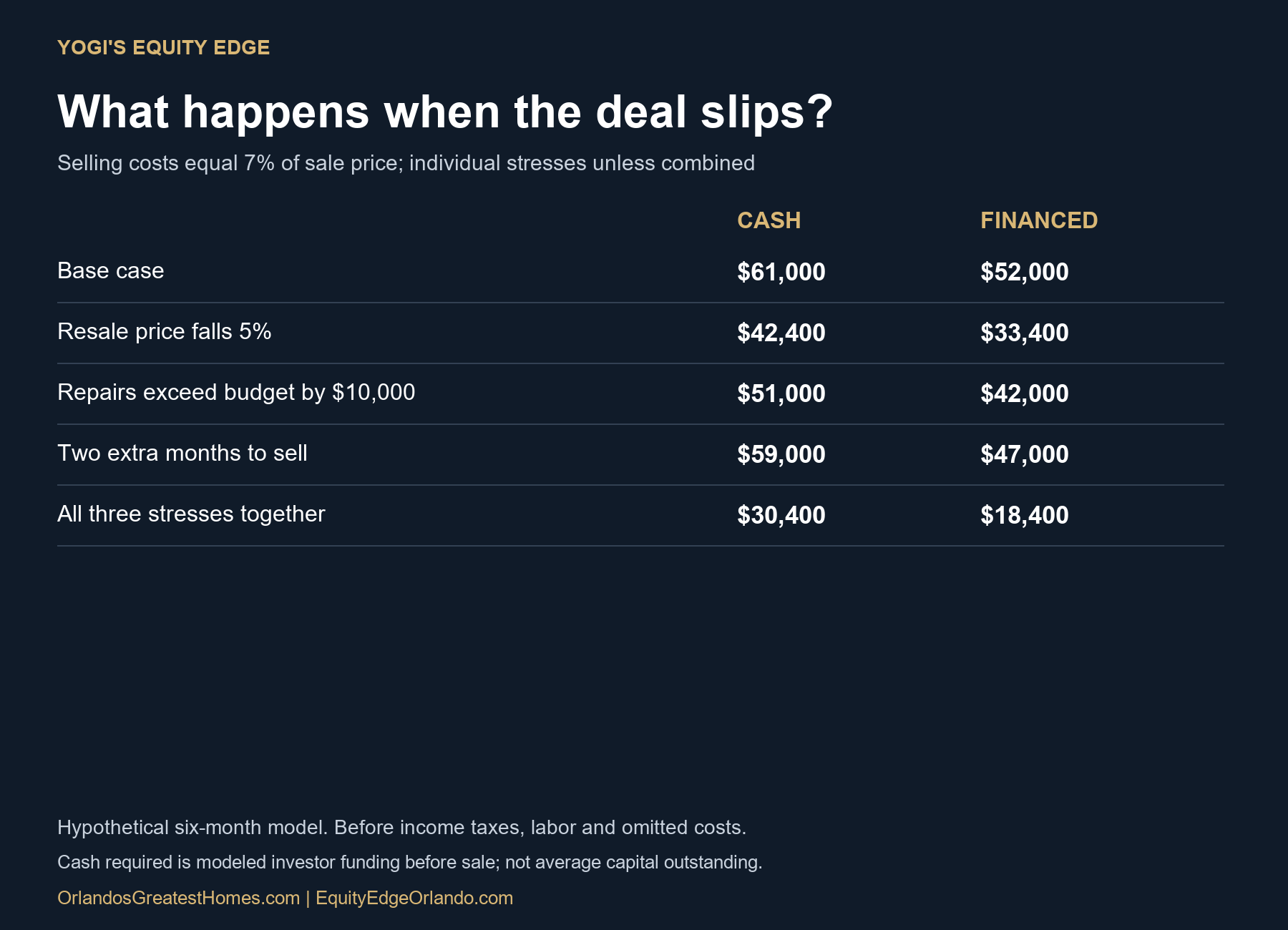
The resale price falls 5%. A $400,000 exit becomes $380,000. With non-selling costs held fixed and selling costs reduced to 7% of $380,000 ($26,600), profit falls to $42,400 cash or $33,400 financed.
The renovation runs $10,000 over the full budget. Profit falls to $51,000 cash or $42,000 financed. That overrun is additional to the stated $110,000.
The sale takes two more months. Assume $1,000 per month of extra property carrying costs for both buyers, plus a conservative $1,500 per month financing allowance for the financed buyer. The cash buyer spends $2,000 more and keeps $59,000. The financed buyer spends $5,000 more and keeps $47,000. These are illustrative monthly assumptions; extension fees are excluded.
All three happen. A $380,000 resale, $120,000 renovation, and two extra months leave $30,400 cash or $18,400 financed. Selling expenses are 7% of the $380,000 sale price ($26,600) in this scenario. Actual fees and other costs must still be checked.
The model still shows a profit in those scenarios, but it does not establish that the property is a good buy. A major structural issue, a larger overrun, title trouble or a much lower exit value could change the outcome.
The $400,000 exit needs evidence
Before treating the projected margin as real, verify closed comparable sales supporting the finished value. Compare the property’s location, size, condition and features, with adjustments you can explain.
Then get a written renovation scope and contractor pricing. Confirm permits, insurance, taxes, title, access and possession. A $110,000 renovation budget needs a schedule and a plan for surprises.
For the loan, check how much money is available at closing, whether any amount is held back, and what happens if the lender requires more cash. The $168,000 contribution is a model, not a recommended reserve or a promise that you will never need additional money.
For another check, choose your target profit. At a hypothetical $30,000 target, fixed non-purchase costs of $149,000 cash or $158,000 financed imply maximum purchase prices of $221,000 or $212,000 respectively. Financing costs may change with purchase price, so rerun actual terms. The target is a decision input, not an industry rule.
What if you keep it as a rental for five years?
You do not have to sell after the renovation. For a cash purchase, use the same $311,000 invested before sale: $190,000 purchase, $110,000 renovation, $5,000 purchase closing, and $6,000 initial carrying costs.
Now assume the renovated property rents for $2,600 per month and leaves $1,800 per month after property operating expenses. That implies an $800 monthly expense allowance. For this model, that allowance must cover taxes, insurance, management, maintenance, vacancy and capital-replacement reserves. Verify those costs separately; $1,800 is an assumption, not guaranteed spendable income. It is before personal income taxes and any loan payments.
Annual net operating cash flow: $1,800 × 12 = $21,600.
Annual cash yield on the $311,000 invested: about 6.9%.
Five full rental years: $1,800 × 60 = $108,000.
Five-year income-only return: $108,000 ÷ $311,000 = about 34.7%, with the property still owned.
This assumes five full years of rental operations after renovation, so the acquisition-to-exit calendar is approximately five and a half years if the initial work takes six months. Rent and net income are held flat, with no reinvestment or appreciation assumed. Vacancies and reserves must already be reflected in the net figure; larger costs or lower occupancy reduce the result.
If you sell after those five rental years
Keep the eventual sale price at $400,000 and assume selling costs of 7%, or $28,000. A debt-free sale leaves $372,000. Subtract the original $311,000 invested and the sale contributes $61,000 of modeled profit.
Add $108,000 of rental cash flow and the combined modeled profit is $169,000 before income taxes and omitted costs. That is about 54.3% of the original investment over the full project, not a yearly return or IRR. The $372,000 sale proceeds include the return of your original capital; they are not all profit. The sale price and selling allowance are assumptions, not five-year forecasts.
Compare the tradeoff: the six-month cash flip models $61,000 profit and returns your capital sooner. The rental models $108,000 of operating cash flow over five years while capital remains committed, plus a possible sale outcome later. The $169,000 includes the same $61,000 sale profit once; it is not an additional $169,000 on top of the flip profit.
The financed rental needs a separate loan model. Deduct the actual long-term debt payments from the $1,800 monthly operating net, then include any refinance costs, ongoing loan balance and sale payoff. The six-month purchase loan cannot simply be assumed to stay in place for five years. This cash model also does not establish the tax treatment or suitability of an IRA investment.
Holding the rental: a 7.5% DSCR illustration
For a long-term rental, use 7.5% annual interest as my DSCR planning assumption. DSCR financing belongs in the rental analysis; do not assume it is available for an unfinished flip or a time-sensitive auction purchase. For example, Lima One describes refinancing a fix-and-flip loan into a separate DSCR rental loan. Eligibility, property condition, rent qualification, seasoning and prepayment terms must be checked with the lender.
For payment illustration only, assume a new $152,000 loan at 7.5%, fixed and fully amortizing over 30 years, starting when rental operations begin. Principal and interest would be about $1062.81 per month. Subtract that from the assumed $1,800 operating net and approximately $737.19 per month remains before personal income taxes. Property taxes and insurance are already in the operating expense allowance and must not be deducted twice.
At unchanged rent, expenses and payment, that is approximately $44232 of cash flow over five full rental years. This is not a complete financed five-year investment return: acquisition and bridge costs, refinance fees, investor cash committed, principal paydown and the eventual loan payoff must also be modeled. The 30-year term and $152,000 balance are illustrative assumptions, not an approved loan or refinance quote.
Your first flip, a rental, or retirement-account investing?
For a first flip, the focus is the total cash required, the renovation scope, the resale evidence and the deadline. The projected sale proceeds only arrive if the work and exit are completed.
For a buy-and-hold rental, a flip profit is not a rental analysis. I would evaluate rent against vacancy, repairs, capital reserves, management, taxes, insurance and debt service. A projected $400,000 resale value does not establish monthly cash flow.
For IRA investing, the ownership, funding and transaction structure need a separate review with the custodian and qualified tax/legal advisers before bidding. The IRS warns that real estate investments can create prohibited-transaction risks; its prohibited-transaction guidance includes buying property for personal use. Do not assume the personal-cash or financed structure illustrated here can simply be transferred into an IRA.
I help clients and investors look for properties that fit the intended plan. Finding a low purchase price is one step; understanding what you are buying and whether it fits your capital, experience and exit is the larger job.
Looking for your first flip, a buy-and-hold rental, or a property to evaluate for IRA investing? Reply with your goal, target area and budget so we can discuss the acquisition approach that fits.
— Yogi Ganeshram
I’m a traditional real estate agent helping buyers and sellers, and an investor with distressed-property experience. My track record includes 23+ years in real estate, 500+ homes sold, 200+ flips, and 400+ short sales with deficiency waivers secured. These experience measures may overlap.
Buying or selling a home: Orlando’s Greatest Homes
Real estate investing: Equity Edge Orlando
Educational information. All figures, terms and timelines are hypothetical. Returns exclude income taxes, investor labor, business overhead, opportunity cost and omitted expenses. This is not individualized investment, legal or tax advice.