
On November 3, Florida votes on the biggest property tax change in decades.
Most of the coverage is about homeowners. Will my bill go to zero? Does my county lose money? Fair questions. But almost nobody is answering the one my investor clients keep asking me:
“What happens to my rentals?”
Short answer: the tax cut isn’t for you. You get one smaller benefit. And depending on how your city and county respond, you could end up paying more. Here’s the whole picture.
What’s Actually on the Ballot
Amendment 3 needs 60% of the vote. If it passes, three things change:
• Bigger homestead exemption. The exemption on non-school taxes goes from about $51,000 today to $150,000 in 2027 and $250,000 in 2028, then rises with inflation. It also sets a path toward eliminating those taxes on homesteads entirely.
• Smaller cap for everyone else. The yearly cap on assessment increases for non-homestead property drops from 10% to 5% starting January 1, 2027.
• A wait for newcomers. New residents phase into the bigger exemption and get the full benefit after five years.
School taxes don’t change. They’re a big piece of every bill, so keep that in mind when you hear “property taxes go to zero.”
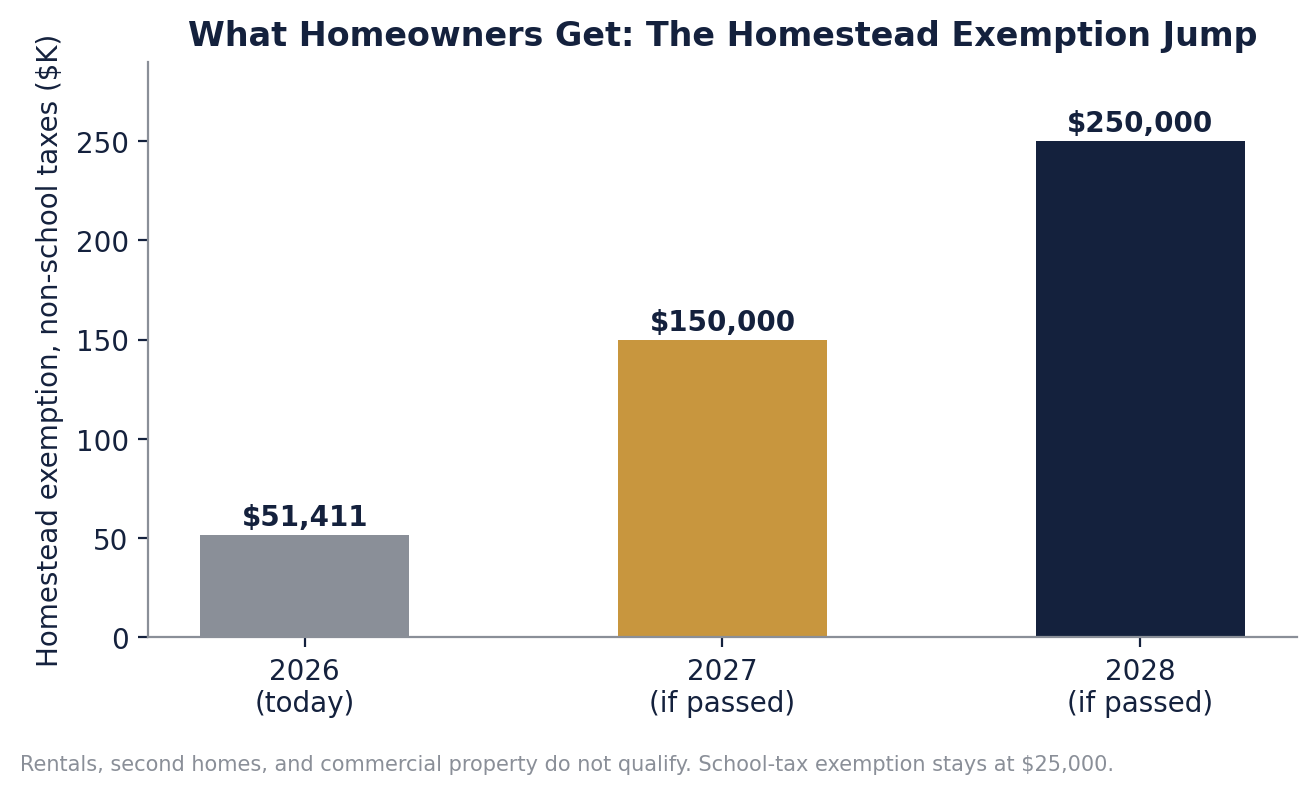
Source: CBS Miami; current exemption from Walczak Policy
The Part Nobody Tells Landlords
Florida TaxWatch says it plainly: rental property, second homes, and commercial property don’t qualify for the bigger exemption. Only your primary residence does.
So if you own a single-family rental, a duplex, a small apartment building, or a vacation home, the headline tax cut does nothing for that property.
Think about who that leaves out. About 32% of Florida households rent. For households under 35, it’s nearly 65%. Inside Orlando city limits, 63% of residents rent. None of them get a homestead break.
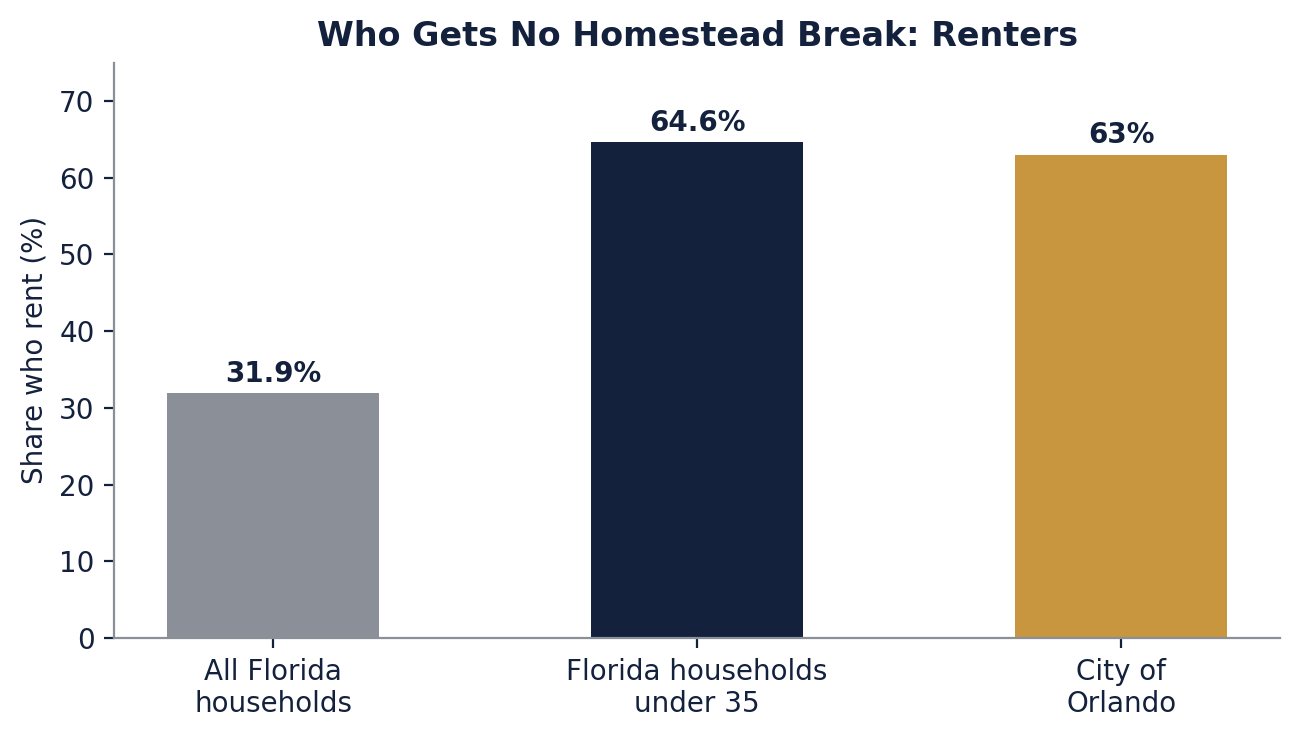
Source: Walczak Policy (Census ACS); City of Orlando
Your One Benefit: The 5% Cap
Rentals do get something. Right now, the assessed value on a non-homestead property can rise up to 10% a year for non-school taxes. Amendment 3 cuts that to 5%.
Here’s the catch. The cap only matters in years when values climb faster than 5%. In a flat or slow market like this one, it does nothing. It pays off in boom years, like 2021 and 2022, when values jumped and assessments chased them.
One analysis of the amendment called the cap’s benefit modest next to the homestead exemption. I agree. It’s real, but it’s insurance against the next run-up, not a cut you’ll feel next year.
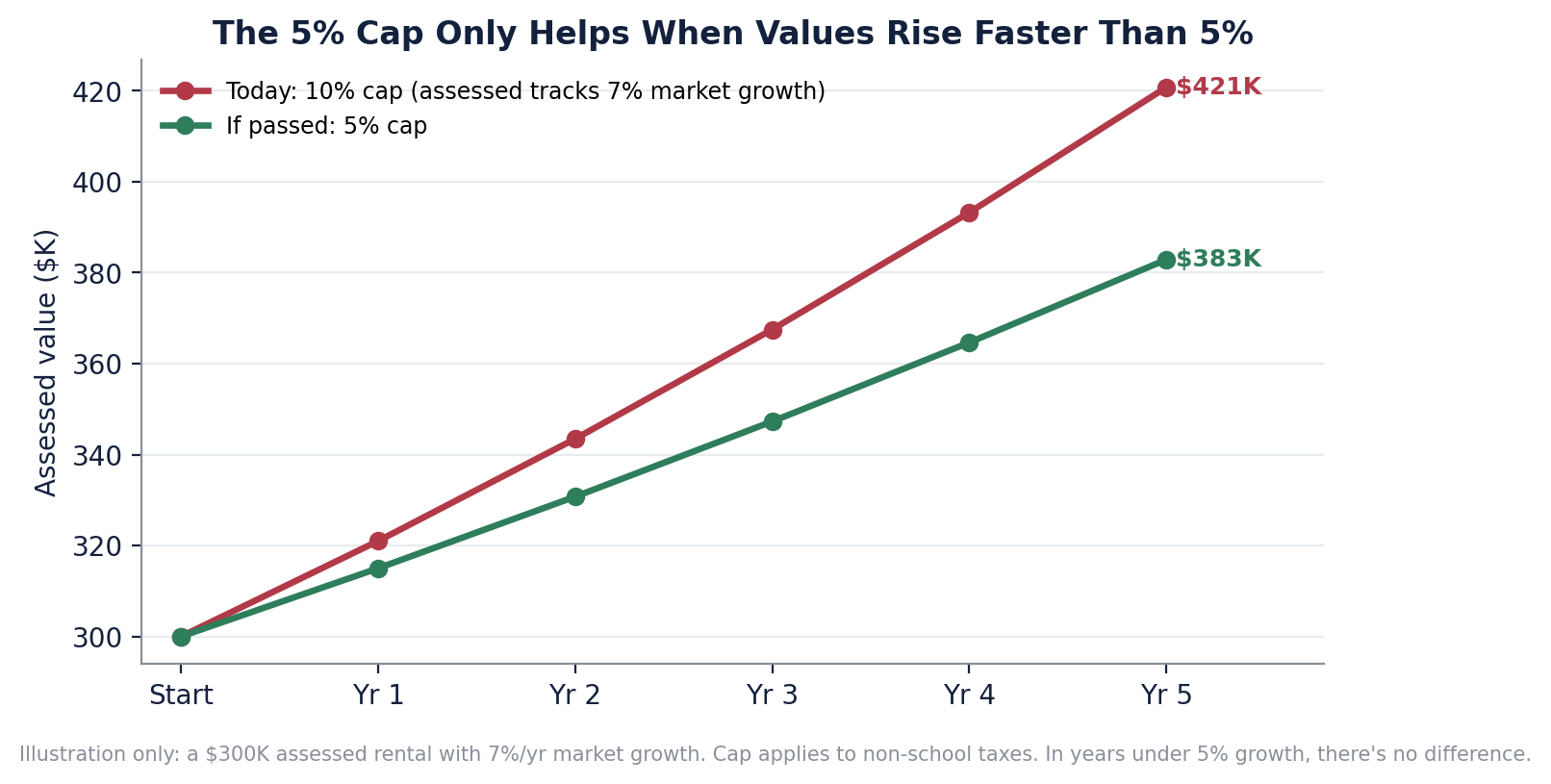
Source: Illustration based on the amendment’s cap change. Not a forecast.
Follow the Money
Every dollar homeowners save comes out of a local budget. Florida’s own Revenue Estimating Conference puts the hole at $4.93 billion in the first year and $11.83 billion a year by FY 2032. That’s roughly a fifth of all non-school property tax collections.
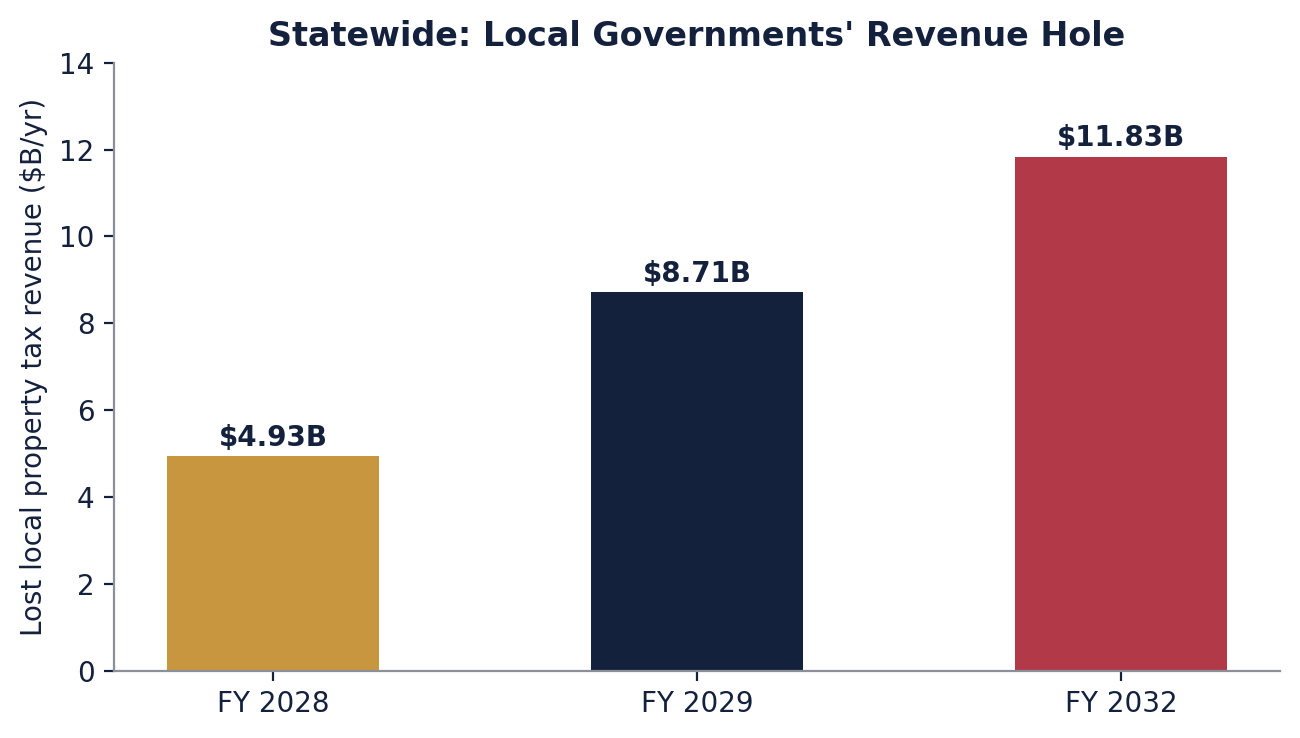
Source: Florida Revenue Estimating Conference, via Walczak Policy
What it looks like here
• Orange County estimates it would lose about $165 million in 2027 and $275 million in 2028.
• City of Orlando proposed a hiring freeze if it passes. Its budget manager said the city may have to consider raising its millage rate for the first time in 13 years.
• Apopka already approved a millage increase this summer, 10% above the rolled-back rate.
• Sanford expects to lose about $15.3 million over two years and is weighing a fire assessment fee.
• Winter Garden already raised business tax receipts 5% to lock in steadier revenue.
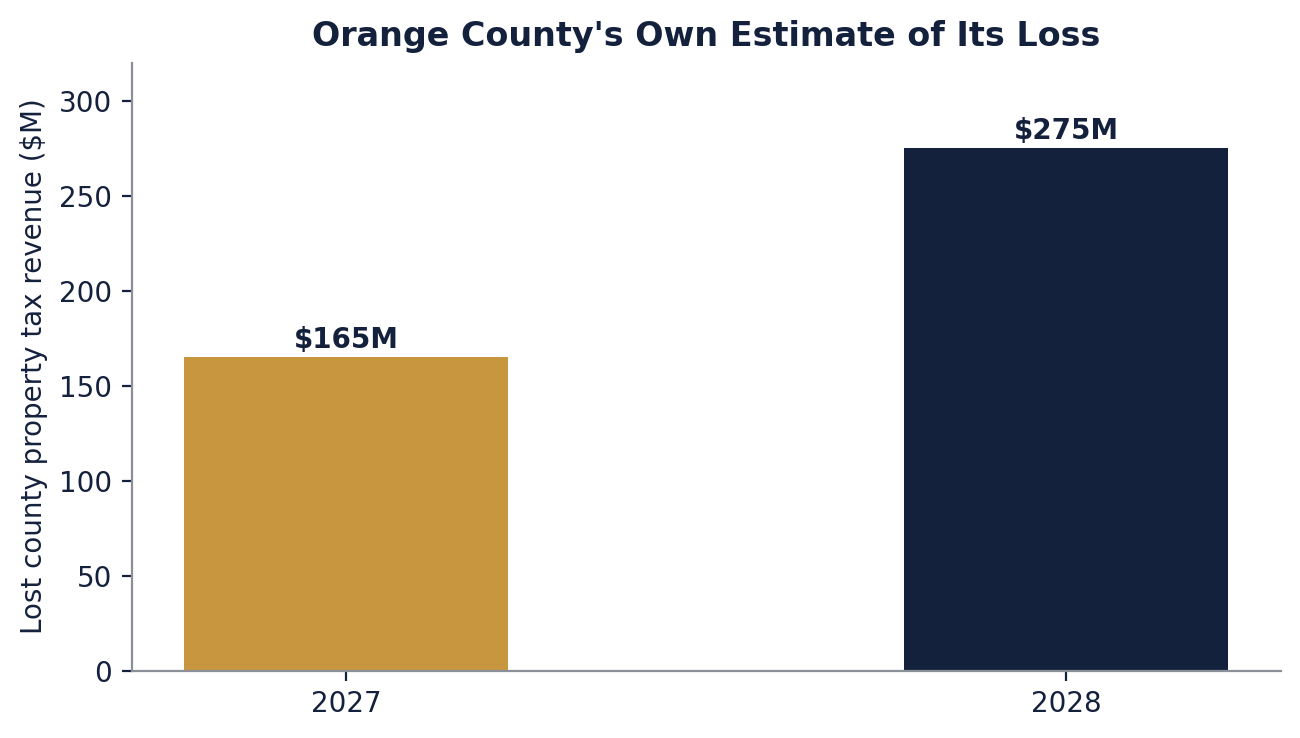
Source: Orange County Government
Notice the pattern. Cities aren’t waiting for the vote. They’re already looking at fees and rates. And Florida TaxWatch notes nothing in the amendment stops local governments from raising millage or adding fees to make up the gap.
The Tax Shift: Where Rentals Get Hit
If cities and counties raise rates to replace the lost money, the new rate applies to everything still on the tax roll. Homesteads are mostly shielded by the bigger exemption. Rentals aren’t.
A September study by Jared Walczak modeled exactly that, parcel by parcel, using state property records. Full disclosure: it was produced with support from housing and apartment groups that have a stake in the outcome. But the method is detailed, and it’s the only county-level estimate I’ve found. In its revenue-neutral scenario for 2028:
• Homeowners with a homestead save about $6.45 billion net.
• Non-homestead residential property, which includes rentals, pays about $3.47 billion more.
• Commercial and business property pays about $2.65 billion more.
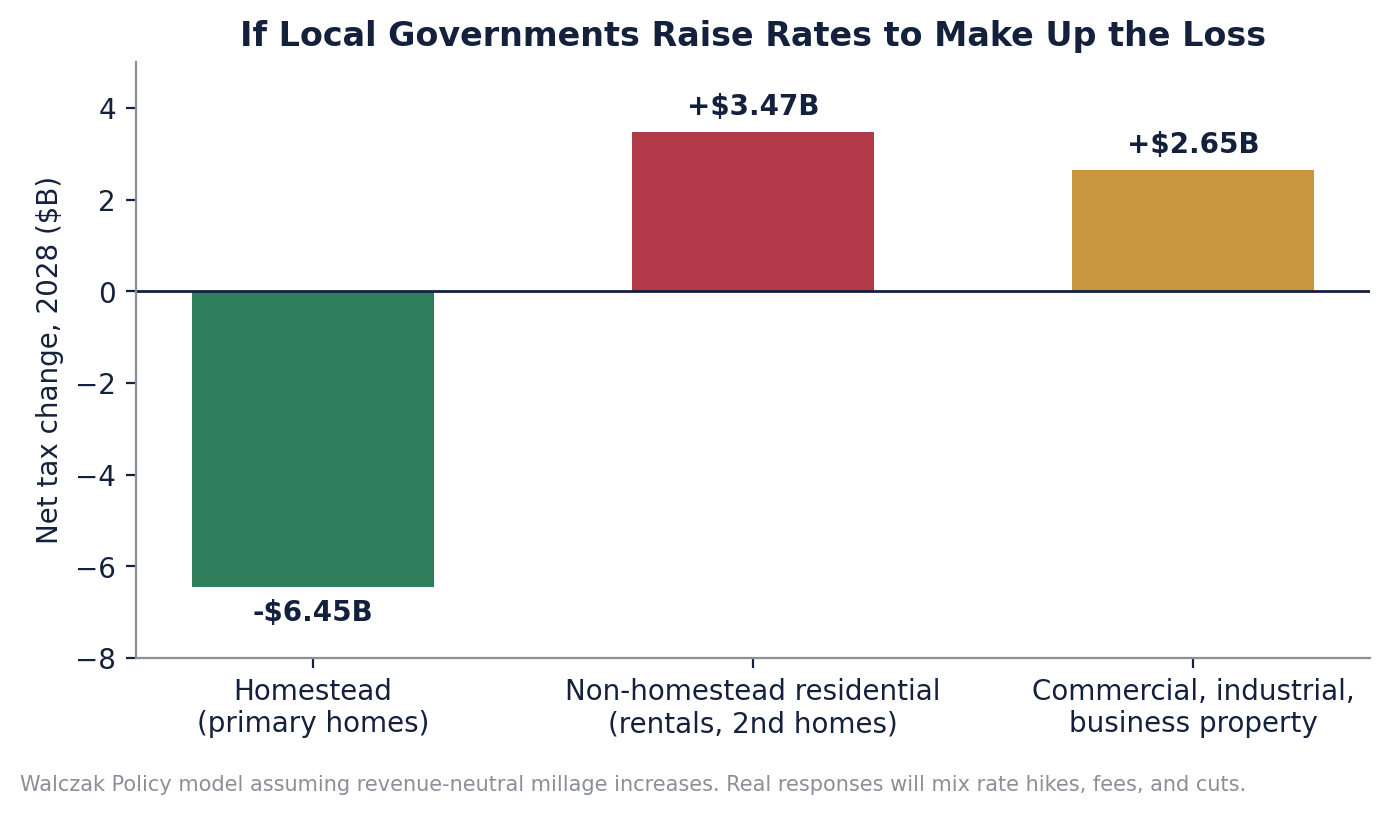
Source: Walczak Policy, September 2026
Statewide, that works out to about $1,081 more per year on the average single-family rental in 2028 and about $1,471 by 2031. For apartments, it’s about $406 per unit.
Central Florida, county by county
Orange County comes in below the statewide average, at about $780 per single-family rental. The counties around us are higher. Lake, Volusia, and Osceola are all north of $1,300.
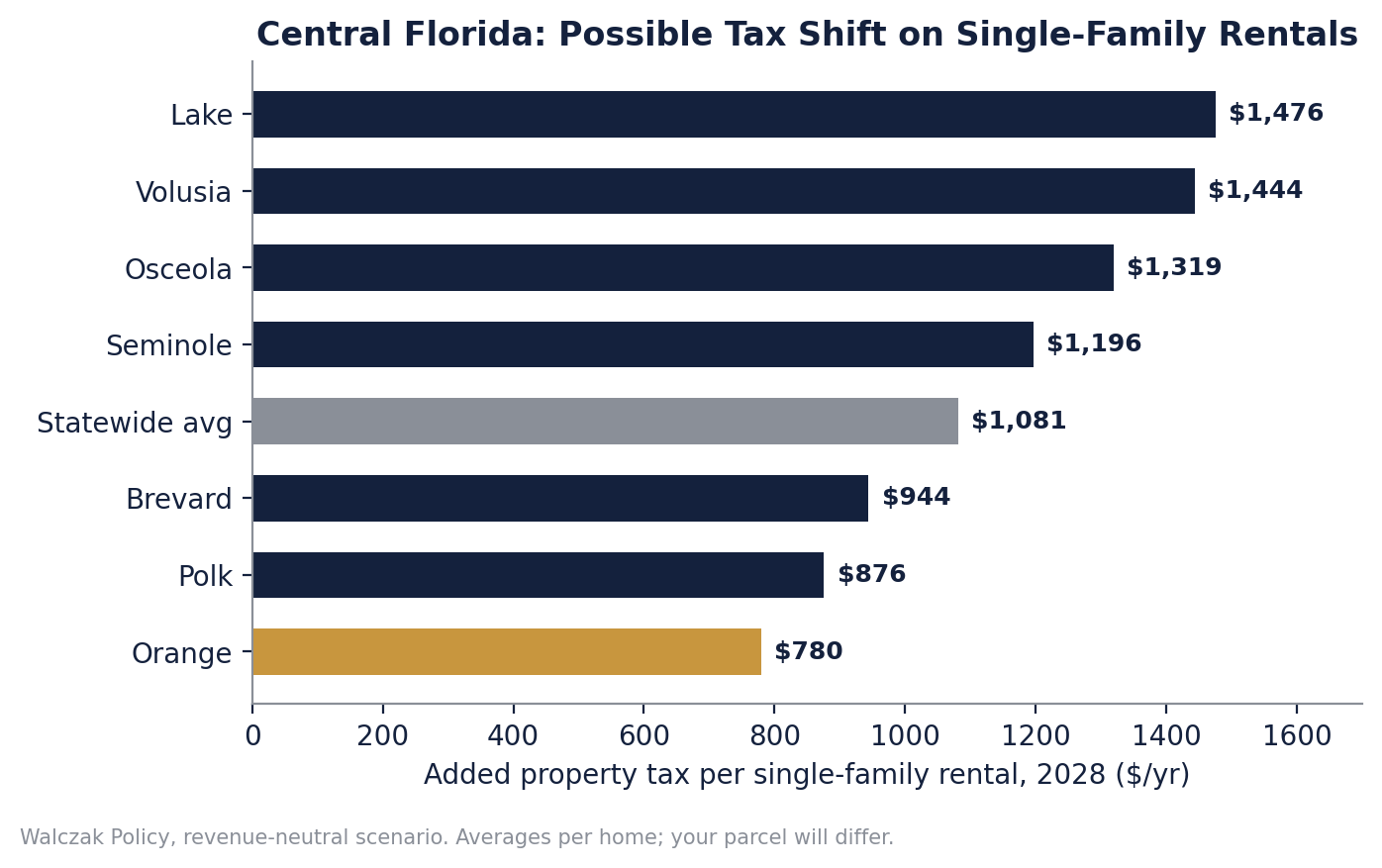
Source: Walczak Policy, Table 4
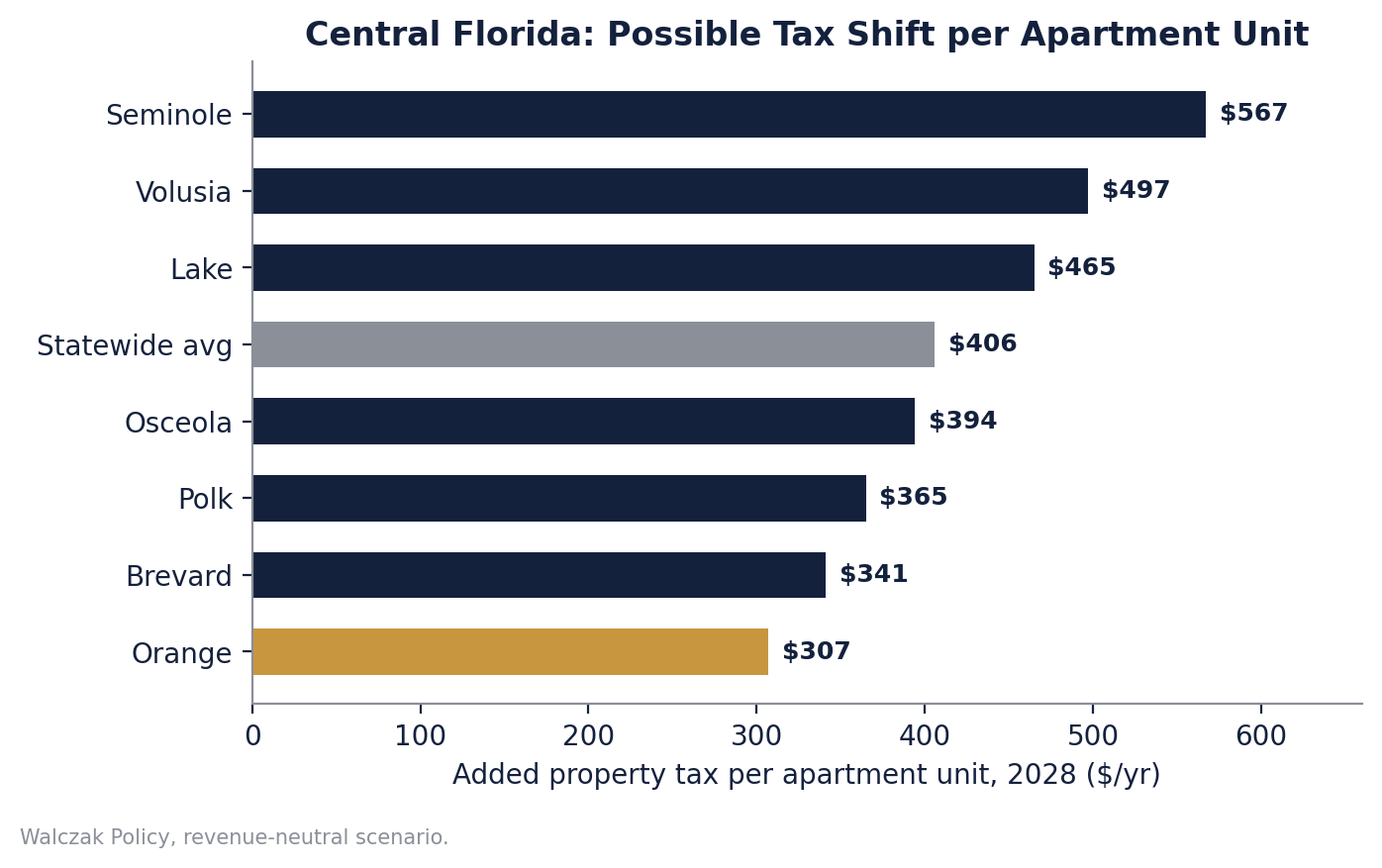
Source: Walczak Policy, Table 4
City by city
City lines matter too. A rental inside Oviedo or St. Cloud could see more than double the shift of one inside Orlando, because those cities lean harder on homestead property for revenue.
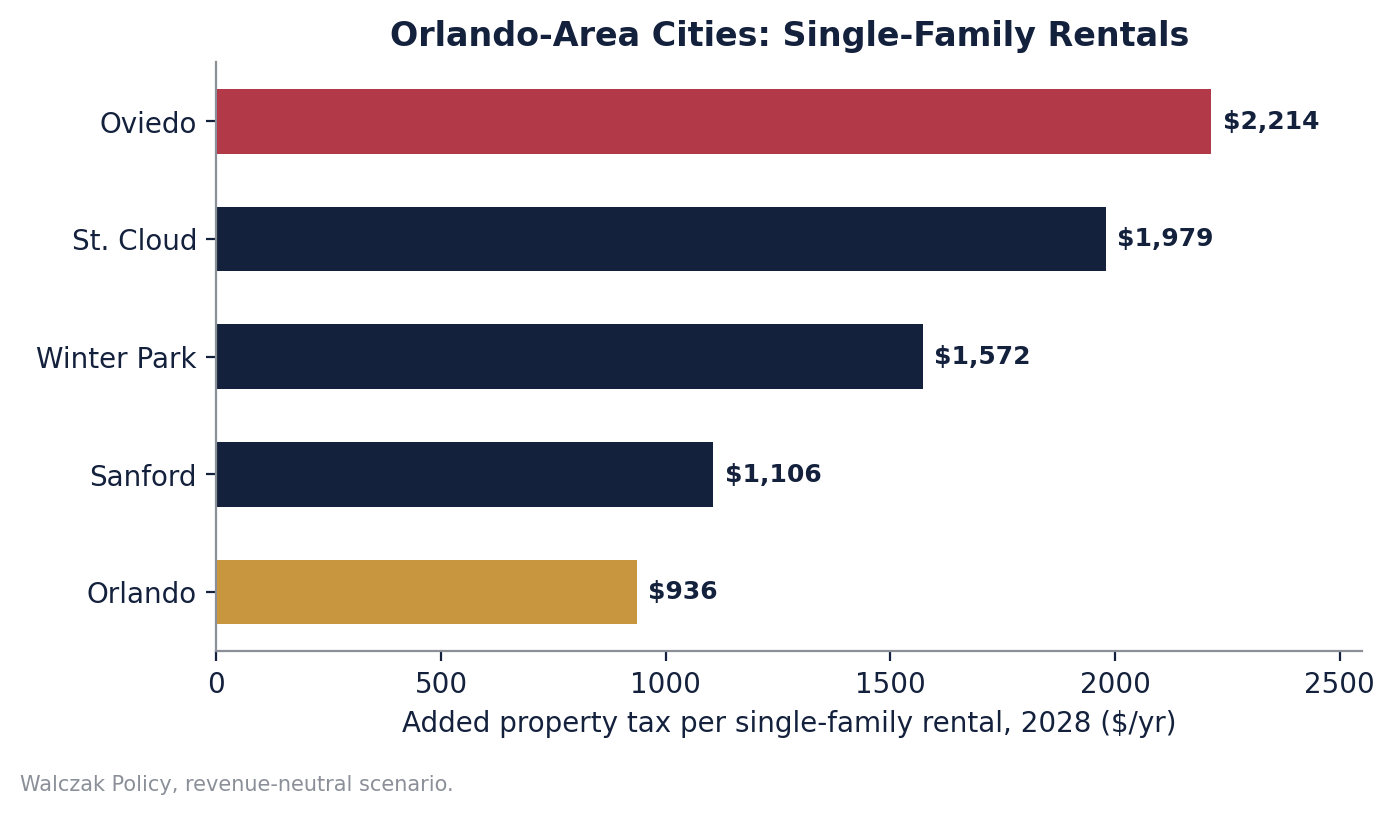
Source: Walczak Policy, Table 5
By rent level
The study also scaled the statewide estimate by rent. Higher rent usually means a higher-value property, which means a bigger share of any rate increase.
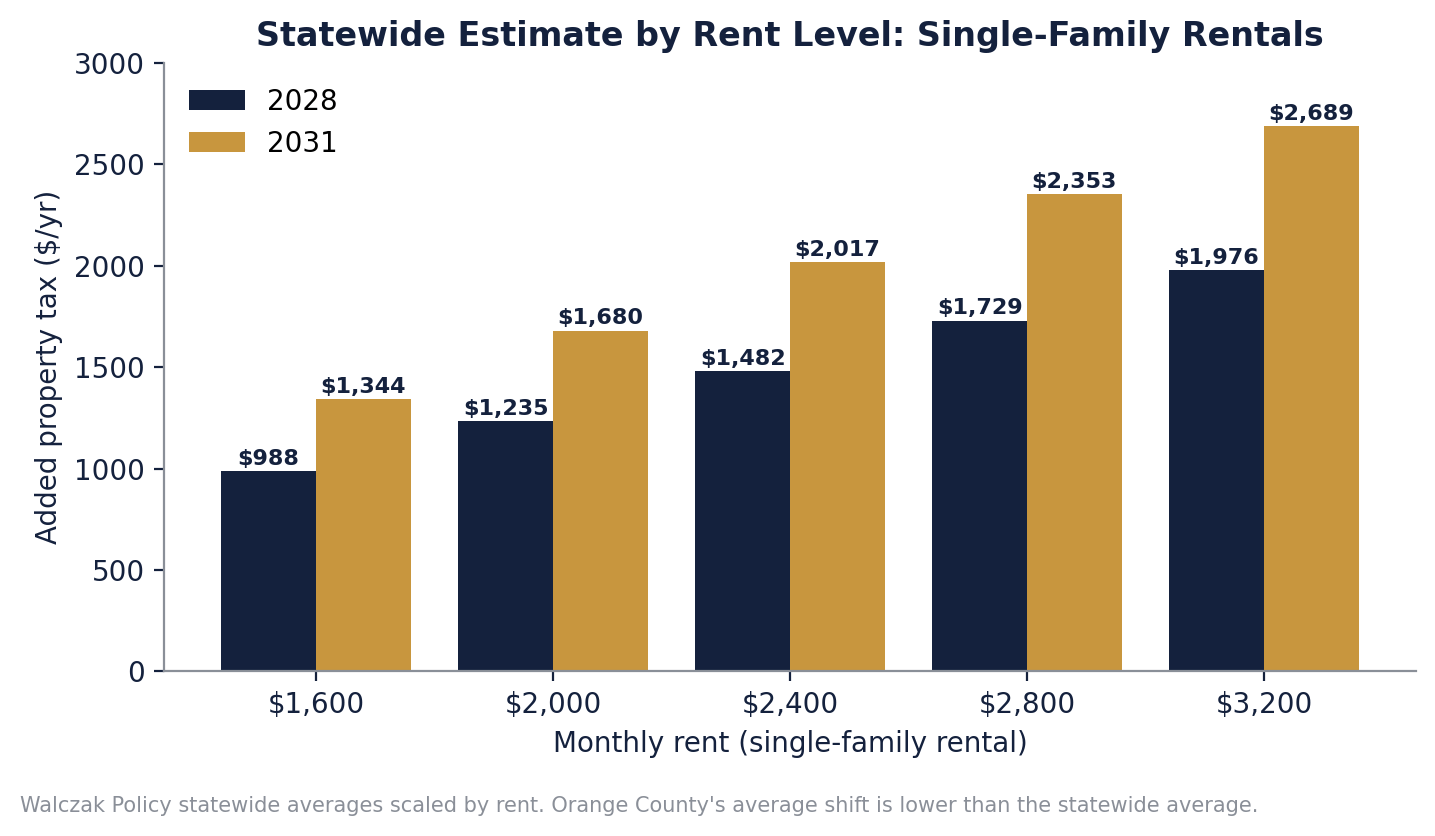
Source: Walczak Policy, Table 3
One important point: this is a model, not a prediction. It assumes local governments raise rates enough to replace the lost revenue. Some will cut spending instead. Some will use fees. Most will do a mix. Treat these numbers as a planning range, not a bill.
I Ran It on One of My Own Rentals
Numbers on a chart are one thing. Here’s what it looks like on a real deal.
In November 2025, I bought a tax deed on Orange Center Blvd in Orlando for $198,100. Full permitted gut rehab, $120,000. Leased at $2,600 a month. All in, $319,497, all cash. The current Orange County tax bill is $3,198 a year. After 10% management and $2,300 insurance, it nets about $22,582 a year, a 7.07% cash-on-cash return.
Now three scenarios, holding rent flat:
• Orange County average shift (+11%): taxes go up about $352. Return drops to 6.96%.
• Statewide rent-level estimate for 2028: about $1,606 more. Return drops to 6.57%.
• Statewide rent-level estimate for 2031: about $2,185 more. Return drops to 6.38%.
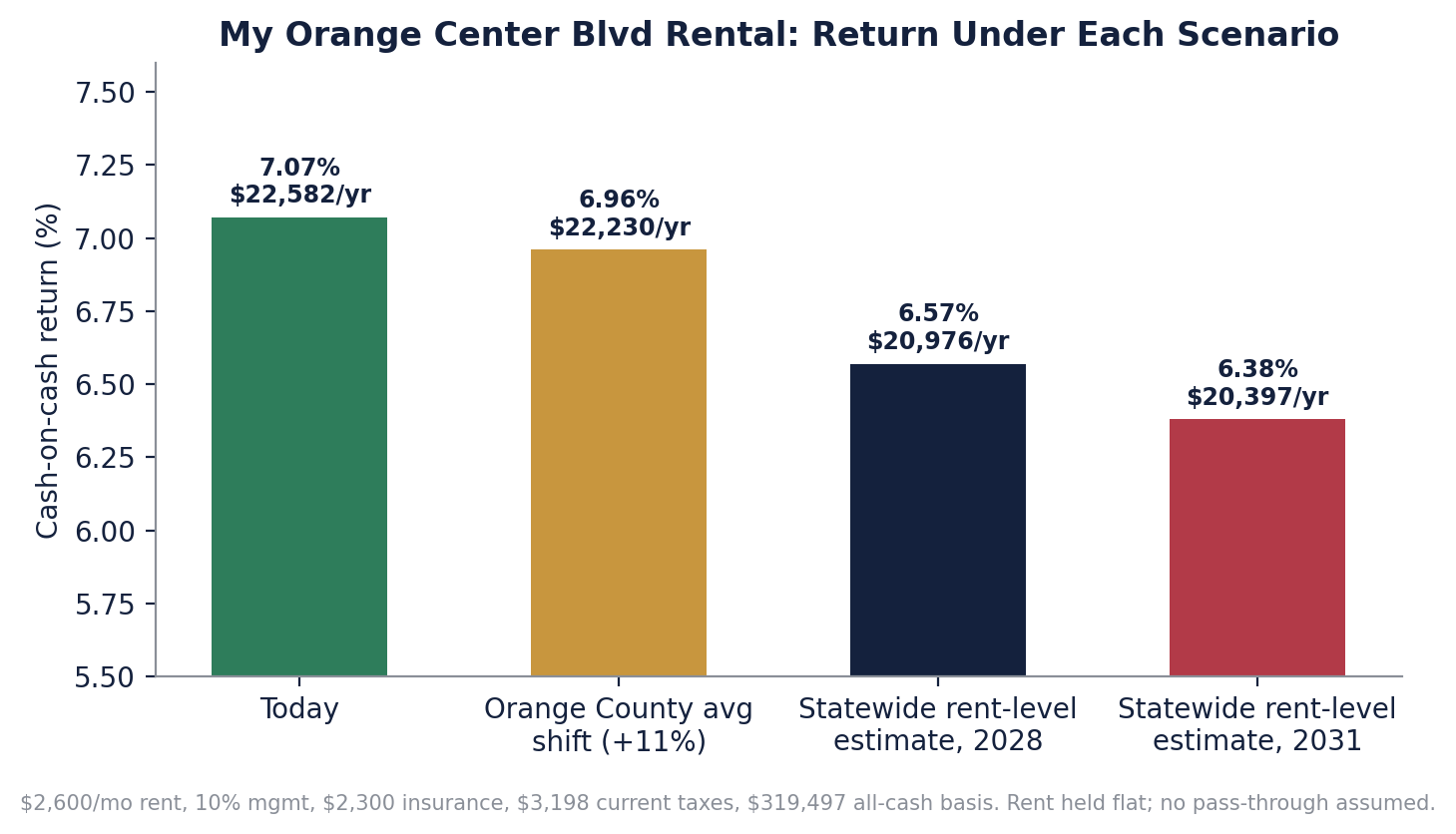
Source: My numbers. Scenarios use Walczak Policy estimates; the rent-level figures are interpolated for $2,600/mo.
Does that kill the deal? No. The deal was bought with margin, so it absorbs the hit. But on a thin deal bought at full retail with a 7% mortgage, $1,500 a year is the difference between cash flow and feeding the property every month.
And yes, some of that cost moves to the tenant. Research cited in the study found landlords pass most property tax increases into rent over time, often within two or three years. The Orange County scenario works out to about $29 a month. Plan for the lease cycle lag.
Will It Pass?
Honestly, it’s close.
• Sachs Media had support at 63% to 64% through mid-August.
• A University of North Florida poll in late July had it at 61%.
• Then a St. Pete Polls survey in September had it at 45%, with 30% opposed and about 25% undecided.
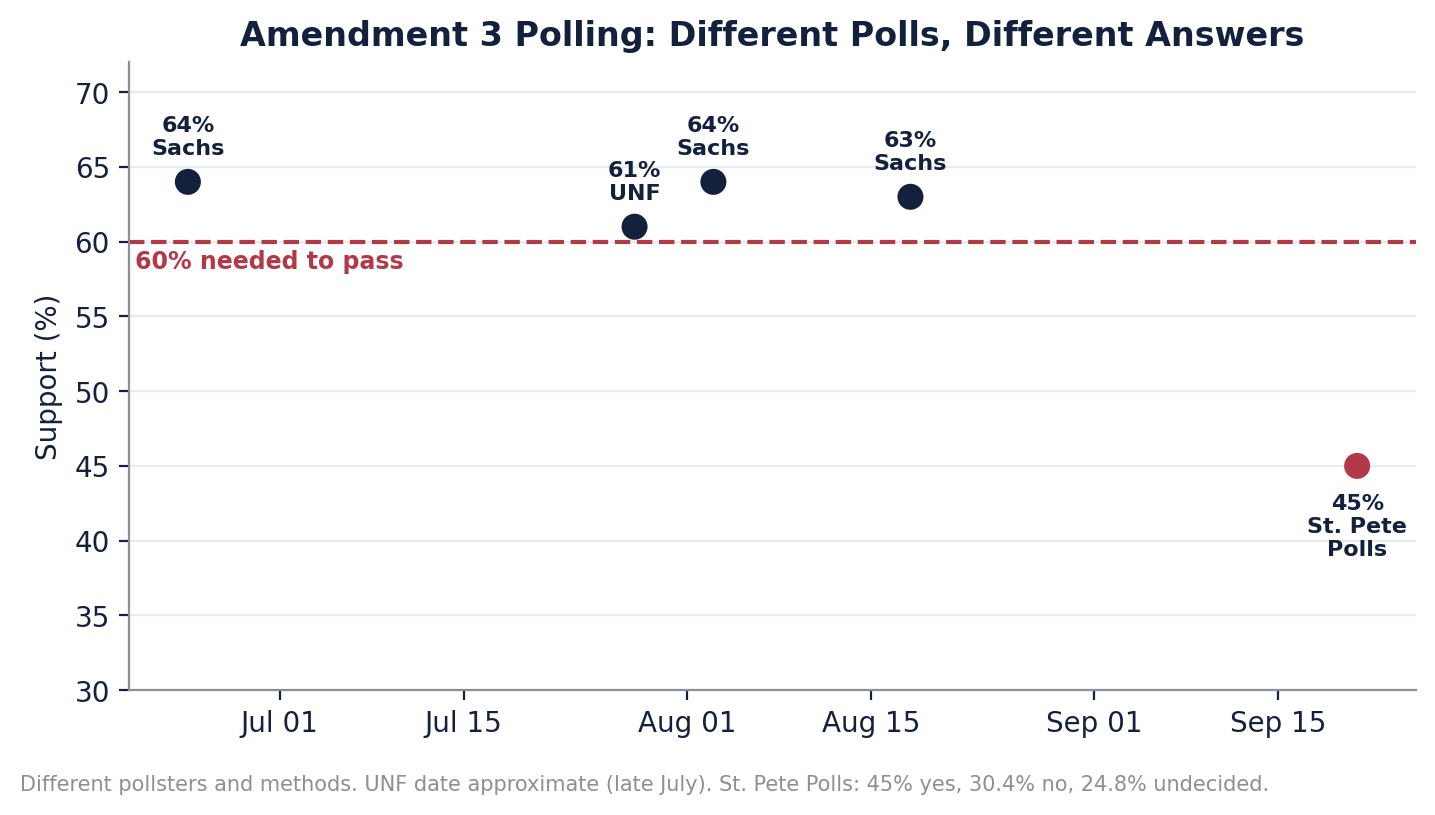
Source: Sachs Media via The Capitolist; St. Pete Polls via WTSP
Different pollsters, different methods, so don’t read that as a straight line. But history says 60% is a high bar. A smaller homestead exemption amendment in 2022 got 58.7% and failed.
Another poll worth knowing: UNF found 63% of insured homeowners worry more about insurance than property taxes. That tracks with what I see at closings.
The Case For and Against
I’m not telling you how to vote. Here’s what each side argues.
Supporters say
• Homeowners, especially long-time residents and retirees, get real relief from rising bills. The governor has said the $250,000 exemption would wipe out the bill for about 60% of homeowners, meaning the non-school portion.
• Local governments have grown budgets fast and can find savings. The governor has said the financial concerns are overstated.
• The 5% cap gives businesses and non-homestead owners more predictable tax bills.
Opponents say
• Local services like police, fire, roads, and parks take the hit, and sheriffs have helped lead the campaign against it.
• Costs shift to renters, small businesses, and non-homestead owners through higher rates and fees.
• New residents wait five years for the full benefit, and long-time owners with low assessed values benefit most.
My Playbook for Rental Owners
Before November 3
1. Pull your last tax bill for every rental. Split out the school portion. Amendment 3 can only move the rest.
2. Check which city each property sits in. As the charts show, city lines can double the exposure.
3. Stress-test your cash flow. Add 15% to the non-school portion of your taxes and see what happens to each property.
If it passes
1. Watch your August TRIM notice. That’s where proposed millage rates show up. Go to the budget hearings or at least read the agenda. Rate hikes happen there, not on Election Day.
2. Watch for new fees. Fire assessments, stormwater fees, and service charges can hit you even when the millage doesn’t move.
3. Review your lease renewals. Build tax changes into renewal pricing. Talk to a real estate attorney before adding any tax pass-through language to a lease.
4. Underwrite new deals with higher taxes. Use the post-amendment number, not last year’s bill. Remember a purchase resets the assessment anyway.
5. Homestead your own home if you haven’t. The exemption is worth far more if this passes.
If it fails
1. Don’t relax. The Legislature can come back with another version, and cities that already raised fees may keep them.
2. Keep the 10% cap in your models. In a boom year, your rental’s assessment can jump fast.
The Bottom Line
Amendment 3 is a homeowner tax cut. Rental owners don’t get it. The 5% cap helps, but mostly in boom years. The real risk is what local governments do to fill a hole that could reach about $12 billion a year.
I bought my rentals on the numbers, with margin. That’s what protects you here too. If a deal only works at today’s tax bill, it’s thinner than you think.
Your Turn
Reply to this email with your county and your rental’s last tax bill. I’ll tell you which scenario you’re closer to, and I’ll use what readers send (no names, no addresses) for a follow-up after the vote.
And in the comments: Are you changing anything in your rental strategy before November 3? I want to hear what other investors are doing.
Forecasts and models are not guarantees. This is market commentary, not tax, legal, or financial advice. Talk to your CPA or attorney about your situation.
Connect With Me
Yogi Ganeshram | Real Estate Agent, eXp Realty LLC
Phone: (321) 217-4220
Email: yogi@orlandosgreatesthomes.com
Website: EquityEdgeOrlando.com
Instagram: @yogisequityedge
TikTok: @yogisequityedge
Facebook: facebook.com/yganeshram
LinkedIn: linkedin.com/in/yganeshram
YouTube: @YogisEquityEdge
Pinterest: @yoganeshram