
Most investors focus on the purchase price, the rehab, and the rent. Very few look at the first-year tax return, and that’s where a lot of the money is.
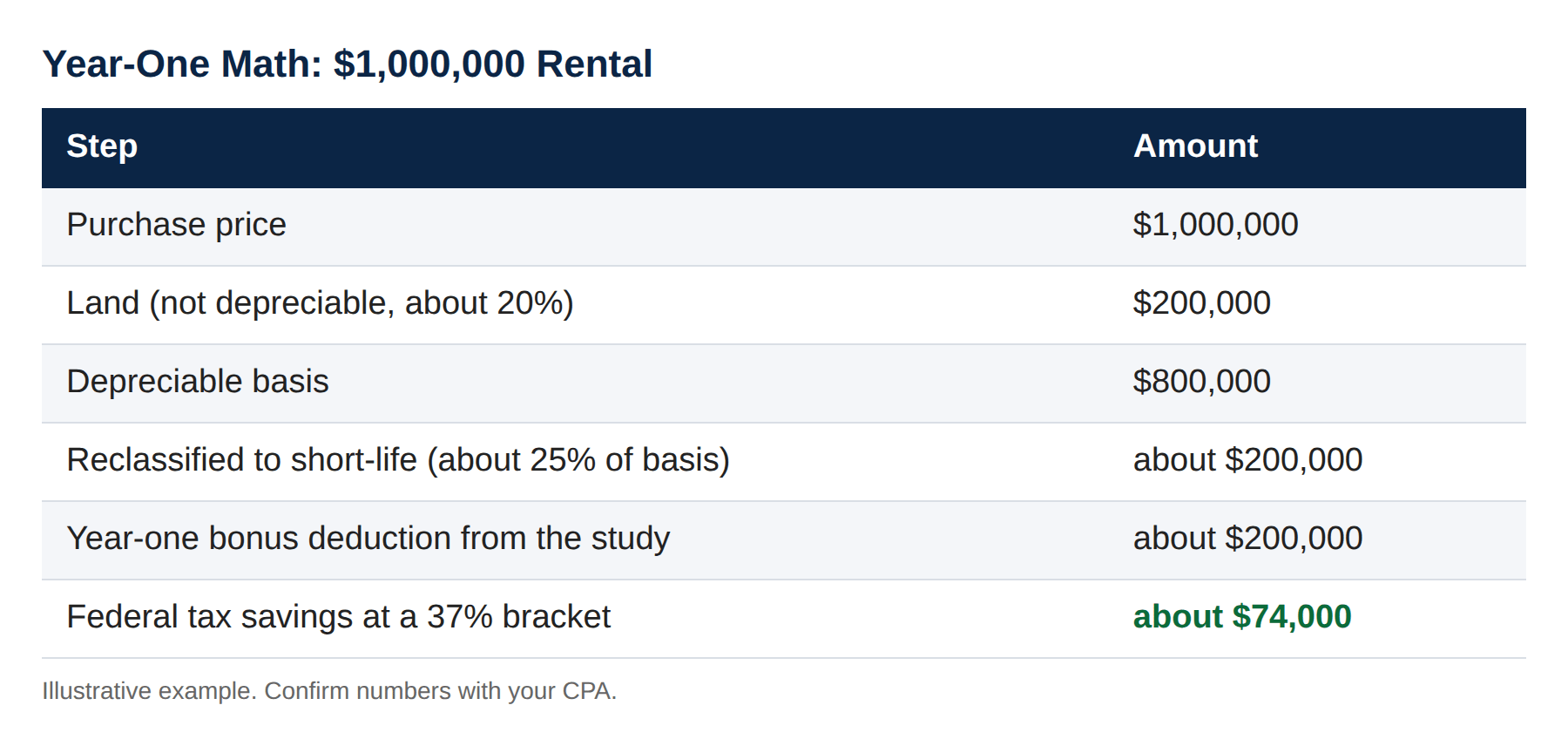
Here’s the play. You buy a $1M rental. A cost segregation study pulls carpet, cabinets, appliances, fencing, landscaping, and other components out of the 27.5-year bucket. With 100% bonus depreciation, you deduct roughly $200,000 of it in year one. At a 37% bracket, that’s about $74,000 in federal tax savings.
Before you get excited, there’s a catch that decides whether you can use it. Let’s walk through all of it.
What cost segregation is
A cost segregation (”cost seg”) study is an engineering-based analysis that breaks a building into its components. The parts that qualify get reclassified from 27.5-year (residential rental) or 39-year (commercial) depreciation into 5-, 7-, and 15-year buckets.
With 100% bonus depreciation, everything in those short-life buckets can be deducted in year one.
Here’s what it is not. It doesn’t create extra depreciation. It moves deductions to the front of your ownership so you keep more cash early and can put it to work on the next deal.
What 100% bonus depreciation means in 2026
The One Big Beautiful Bill, signed July 4, 2025, made 100% bonus depreciation permanent for qualifying property acquired after January 19, 2025.
The acquisition date controls, not the placed-in-service date. Acquisition date is the date of the binding written contract, or the title transfer if there’s no contract.
Property acquired on or before January 19, 2025 stays on the old phase-down: 80% (2023), 60% (2024), 40% (2025), and 20% (2026).
The building shell (27.5/39-year) never qualifies for bonus. Only the components a study pulls out do. No study, no bonus on those components.
Qualifying property includes personal property components, land improvements, qualified improvement property, and computer software.
There’s a 40% election for the first tax year ending after January 19, 2025, if that suits your tax position.
Used property qualifies, as long as you didn’t previously use it and bought it from an unrelated party.
The year-one math
Same property, with and without a study:
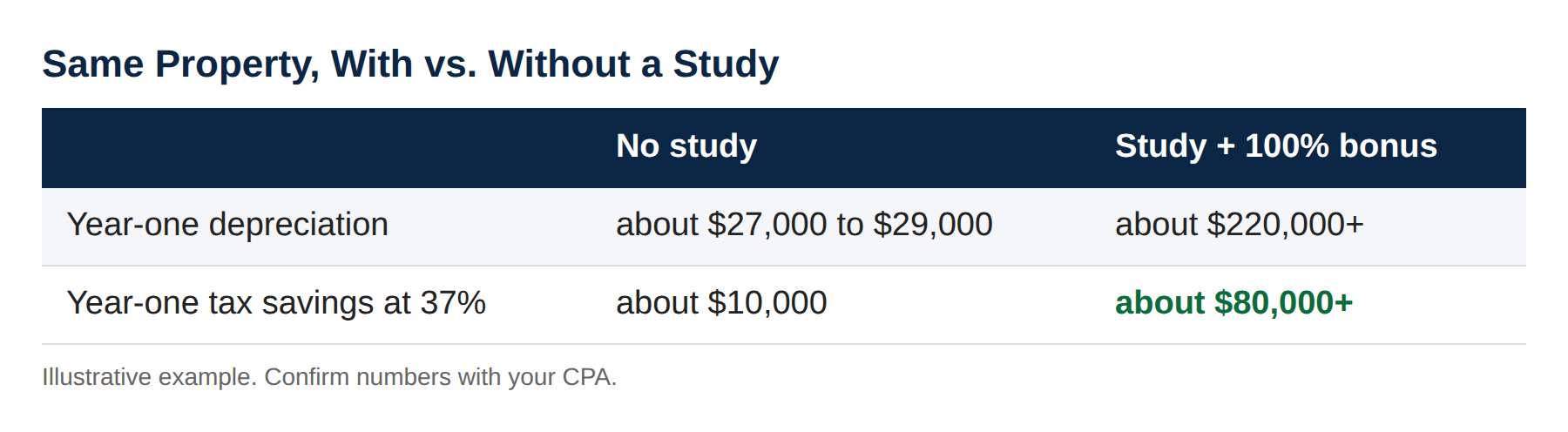
That’s roughly $10,000 in savings versus $80,000 or more, on the same building.
Reclassification percentages vary by property. 15% to 40% of depreciable basis is a realistic range. Renovation-heavy or amenity-heavy properties (pools, pavers, landscaping, finished interiors) land at the high end.
Every category that can be deducted
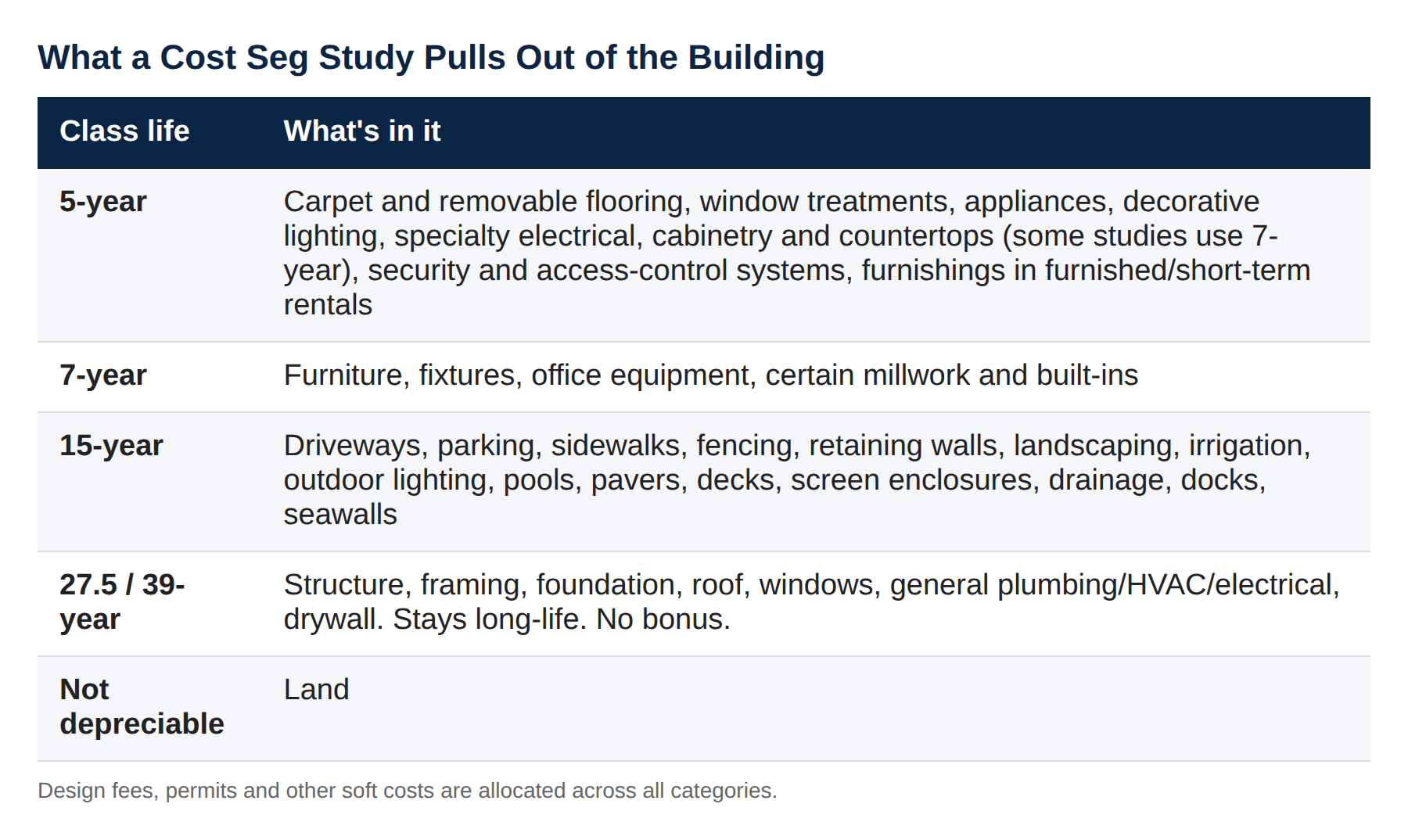
In Florida, watch the 15-year bucket. Pools, pavers, decks, and screen enclosures are common here, and they add up fast.
Flips vs. holds
This one matters for a lot of people reading this. Property held as dealer inventory is not depreciable. Cost seg only works on properties you hold: rentals, short-term rentals, BRRRR, commercial, and build-to-rent.
If you flip, the study doesn’t apply. If a flip converts into a rental, depreciation starts once it’s placed in service as a rental.
Who benefits most: multifamily owners, short-term rental owners, commercial buyers and builders, properties with heavy renovations, investors planning multi-year holds, and anyone with taxable income to offset.
The catch: passive loss rules
A big year-one deduction only helps now if you can use the loss. The IRS treats long-term rental income as passive, and passive losses generally can’t offset W-2, business, or active income. There are four ways around that.
1. The $25,000 active-participation allowance. It applies to owners who actively participate in a rental. It phases out between $100,000 and $150,000 of MAGI, so it doesn’t help higher earners.
2. Real Estate Professional Status (REPS). You need 750+ hours a year in real property trades, and more than half of your total working time must be in real estate. You also have to materially participate in the rentals. REPS makes rental losses non-passive, so bonus depreciation from a study can offset other income.
3. The short-term rental route. If the average guest stay is 7 days or less (or 30 days or less with significant personal services), the activity isn’t treated as a “rental activity” under the passive loss rules. If you also materially participate, the losses become non-passive. The common tests: 500+ hours, or 100+ hours and more than anyone else, or you do substantially all of the work.
4. Carry it forward. Unused losses carry forward and offset future passive income, or the gain when you sell. You keep the deduction but don’t get the cash benefit today.
Documentation is everything. Keep calendars, logs, and maintenance and guest records. Estimates reconstructed after the fact carry little weight in an audit. Time spent on investor-level work like reviewing financials and market research generally doesn’t count toward material participation.
One more limit: Section 461(l) caps how much net business loss non-corporate taxpayers can use against other income each year. It’s roughly $300K single and $600K joint, indexed annually. A very large year-one loss can hit it, and the excess carries forward as an NOL. Ask your CPA for the current-year number.
Recapture: the cost on the back end
Nothing here is free. When you sell, the IRS wants some of it back.
Personal property (5/7-year, Section 1245): the depreciation you took is recaptured as ordinary income, up to the top rate of 37%.
Real property (Section 1250): straight-line depreciation on the building is taxed at a maximum of 25% (unrecaptured Section 1250 gain).
“Allowed or allowable”: the IRS taxes recapture on depreciation you could have taken, even if you never claimed it. Skipping the study doesn’t avoid recapture. It just means you didn’t get the benefit.
The tradeoff is real. Cost seg with 100% bonus turns a chunk of what would have been slow 25% recapture into up-front deductions with potentially higher-rate recapture later.
How investors manage it:
1031 exchange defers recapture. The personal-property (1245) portion needs matching replacement property, or the shortfall triggers recapture.
Hold long term. The time value of the year-one savings is often worth more than the eventual tax.
Step-up in basis at death eliminates recapture for heirs.
Installment sales spread recognition across years.
Suspended passive losses can offset recapture when you sell.
Closing date timing. A January close, for example, pushes recognition into the next tax year.
Already own rentals? Look-back studies
If you’ve owned rentals for years and never did a study, you may be able to capture what you missed.
File Form 3115 (change in accounting method) with your current-year return.
The catch-up is taken as a Section 481(a) adjustment in the current year.
No amended returns are needed.
The bonus percentage follows the original placed-in-service date, not the study date. A rental placed in service in 2022 keeps its 100% rate even if you do the study in 2026. A 2024 acquisition keeps 60%.
It works best when your current income is high enough to absorb the deduction, the property originally qualified for a high bonus rate, and the losses aren’t stuck as passive.
What a study costs and how to buy one
Published 2026 guides put pricing roughly here:
Automated/software-driven: about $100 to $4,500, best for standard residential
Mid-market engineering-based: about $500 to $10,000
National full-engineering firms: about $5,000 to $15,000+, for complex commercial
CPA-firm white-label: about $3,000 to $25,000+, often outsourced with a markup
Rules of thumb:
Under $300K property: about $500. $300K to $1M: about $800 to $1,500. $1M to $5M: about $1,500 to $5,000.
If your estimated year-one tax savings are more than about 5x the study cost, it’s worth doing.
The IRS doesn’t require a site visit for standard residential. A desktop study is generally fine for residential under about $5M.
Ask that the study follow the IRS Cost Segregation Audit Techniques Guide (Pub 5653). Ask about audit support, and who signs off: an engineer or software output.
Skip the CPA markup where you can. Get a direct quote from the underlying provider.
For reference, MVO Cost Seg lists $595 (DIY, basis under $1M), $895 (engineer reviewed), and $2,500+ (fully engineered, audit defense included). For a typical $300K to $700K Florida rental with light rehab, the middle tier fits. Get quotes from a few providers and confirm your CPA is comfortable with a desktop or software-based study before you order.
Other things to confirm with your CPA
Florida has no state personal income tax, so the benefit here is federal only. If you own in a state that taxes income, check whether it follows federal bonus rules.
Depreciable basis is what counts. Make sure closing costs and capitalized rehab are included, and get a solid land allocation from the appraisal or tax assessor.
The placed-in-service date (ready and available for rent) sets the tax year of the deduction. Buy in December, place in service in January, and the deduction moves a year.
Renovations on a rental (new appliances, flooring, landscaping, a pool) can be their own short-life assets, with or without a full study.
Items under $2,500 each can often be expensed directly under the de minimis safe harbor.
Before you buy your next hold, run this checklist
Is it a hold (rental, STR, commercial), not a flip?
Was it acquired after January 19, 2025? If yes, you’re at 100% bonus.
Is the depreciable basis big enough that savings beat 5x the study cost?
Can you use the loss now (REPS, or STR plus material participation), or will it carry forward?
What’s your exit plan (hold, 1031, sell, step-up), and how does it match up with recapture?
Have you documented your hours if you’re relying on REPS or the STR rule?
Is your CPA on board before you order the study?
If you own rentals and never did a study, run your numbers this quarter. Reply with your purchase price and placed-in-service date and I’ll walk through a rough estimate with you. Then take the results to your CPA.
This is education, not tax advice. Confirm your numbers with a CPA who works with real estate investors.
Sources
Short-Term Rentals: Material Participation and Cost Segregation, EisnerAmper
Depreciation Recapture: The Tax Bill Nobody Talks About, R.E. Cost Seg
Look-Back Cost Segregation: Form 3115, 481(a), and Bonus Depreciation, WCG
Connect With Me
Yogi Ganeshram | Real Estate Agent, eXp Realty LLC
Phone: (321) 217-4220
Email: yogi@orlandosgreatesthomes.com
Website: EquityEdgeOrlando.com
Instagram: @yogisequityedge
TikTok: @yogisequityedge
Facebook: facebook.com/yganeshram
LinkedIn: linkedin.com/in/yganeshram
X: @YogiGaneshram
YouTube: @YogisEquityEdge
Pinterest: @yoganeshram