
The Answer First
If you can afford the payment again, keep the house. If you can’t, sell it with the lender’s approval before the foreclosure judgment, and negotiate the deficiency waiver in writing before you close. That is a short sale.
Here is why, in five lines:
• Lenders must look at keeping you in the home first. Federal rules block most foreclosure filings until you are more than 120 days behind, and servicers work through forbearance, repayment plans, deferrals, and modifications before they file (Nolo on Regulation X).
• A short sale costs the lender less than a foreclosure, so they approve it. That is your leverage.
• A short sale lets you negotiate the deficiency up front. After a foreclosure, the lender can pursue the shortfall and you just wait (Nolo on Florida foreclosure).
• The credit hit is similar, but the wait to buy again is not: 4 years after a short sale versus 7 after a foreclosure for a Fannie/Freddie loan (waiting-period summary).
• Doing nothing is the worst option. The protections are time-based, and ignoring the notices burns them.
The rest of this post shows every option, every timeline, and how I work a file from first call to closing.
Who You Are Really Dealing With
The company you pay is usually the servicer, not the owner of your loan. The owner (the investor) is Fannie Mae, Freddie Mac, a Ginnie Mae pool for FHA/VA/USDA loans, a bank, or a private trust. The servicer collects payments and follows the investor’s rules. Mortgage insurers often get a vote too.
That is why a homeowner who calls the 1-800 number gets a script. The front-line rep usually cannot approve a deficiency waiver or a price below guidelines. The file goes to a negotiator, who checks the investor’s rules, and sometimes the investor or insurer has to sign off.
When I take a file, I find out four things first:
1. Who owns the loan. The servicer must tell you on request, and Fannie and Freddie both offer loan look-up tools.
2. Who insures it. Conventional loans with PMI need the insurer to approve the short sale.
3. What junior liens exist. Second mortgages, HELOCs, HOA, and code liens all have to be released or settled.
4. What the investor pays toward the move. Fannie Mae, for example, lists up to $7,500 in relocation assistance in some short sales (Fannie Mae fact sheet).
Knowing who actually makes the decision, and what that investor’s short sale rules allow, is where experience pays off.
What the Lender Explores Before Filing Lis Pendens
Before a foreclosure suit, servicers generally work a waterfall: keep the homeowner in the house first, then a sale or deed back if that fails. Which options apply depends on who owns or insures the loan. Sources: Fannie Mae forbearance, Freddie Mac payment deferral, Fannie Mae Flex Modification, HUD FHA loss mitigation, HUD notice on the FHA waterfall, and the USDA bulletin.
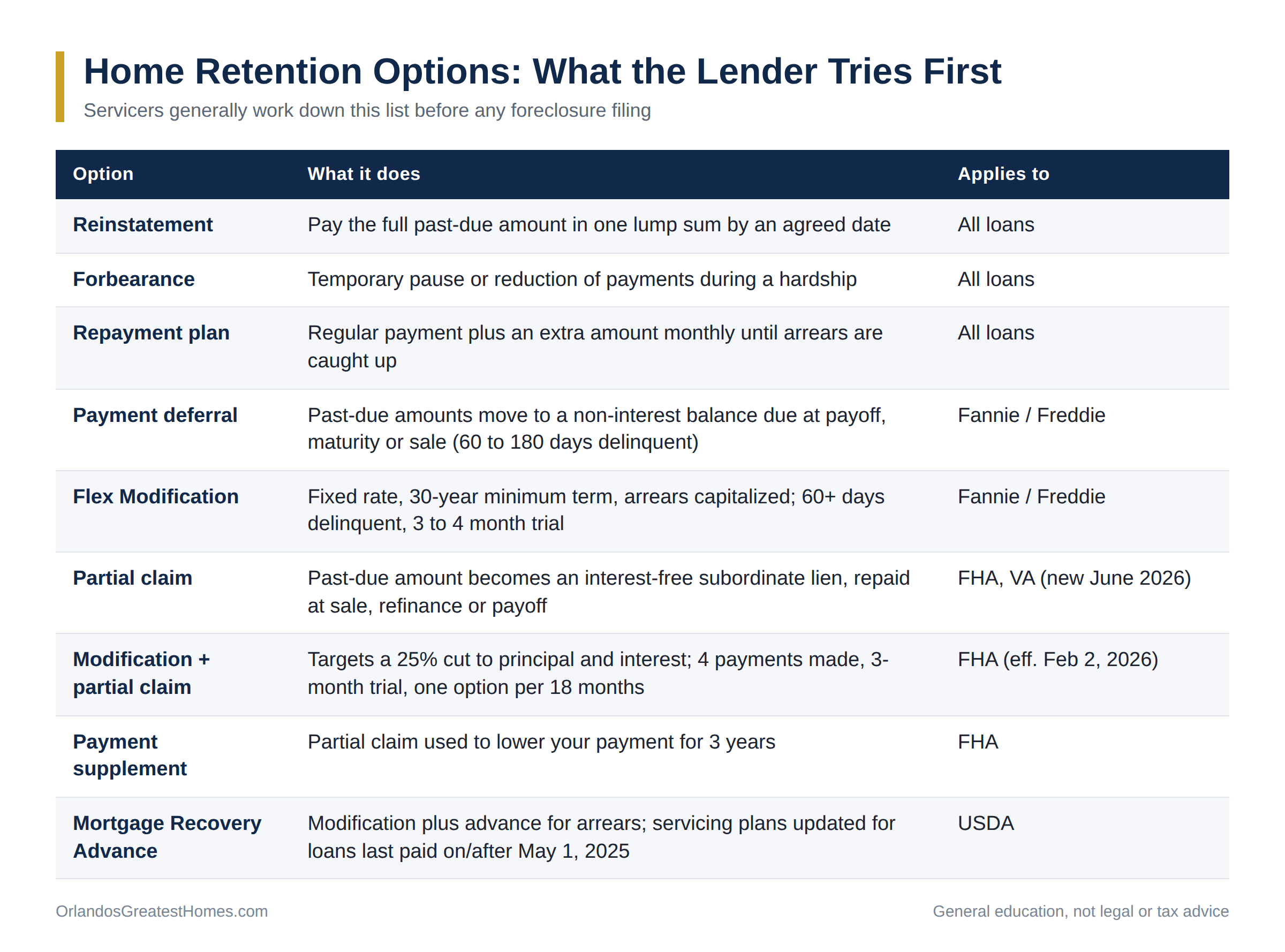
Adding the past-due amount to the back end of the loan is real. Payment deferral (Fannie/Freddie), partial claims (FHA, VA), and the Mortgage Recovery Advance (USDA) all move the missed payments to the end. You resume regular payments, and the past-due amount comes due when you sell, refinance, or pay off. To qualify you generally have to show the hardship is resolved and you can afford the regular payment again.
If keeping the house fails, the disposition options are:
• Short sale. You sell for less than you owe with lender approval. FHA calls it the Pre-Foreclosure Sale and may pay relocation help.
• Deed in lieu. You give the property back in exchange for a release. It usually requires clean title with no junior liens.
Government Protections and Help Available Now
Regulation X applies to nearly all first-lien loans (Nolo summary). VA borrowers now have a partial claim option (VA announcement). The Florida Homeowner Assistance Fund is closed (status summary).
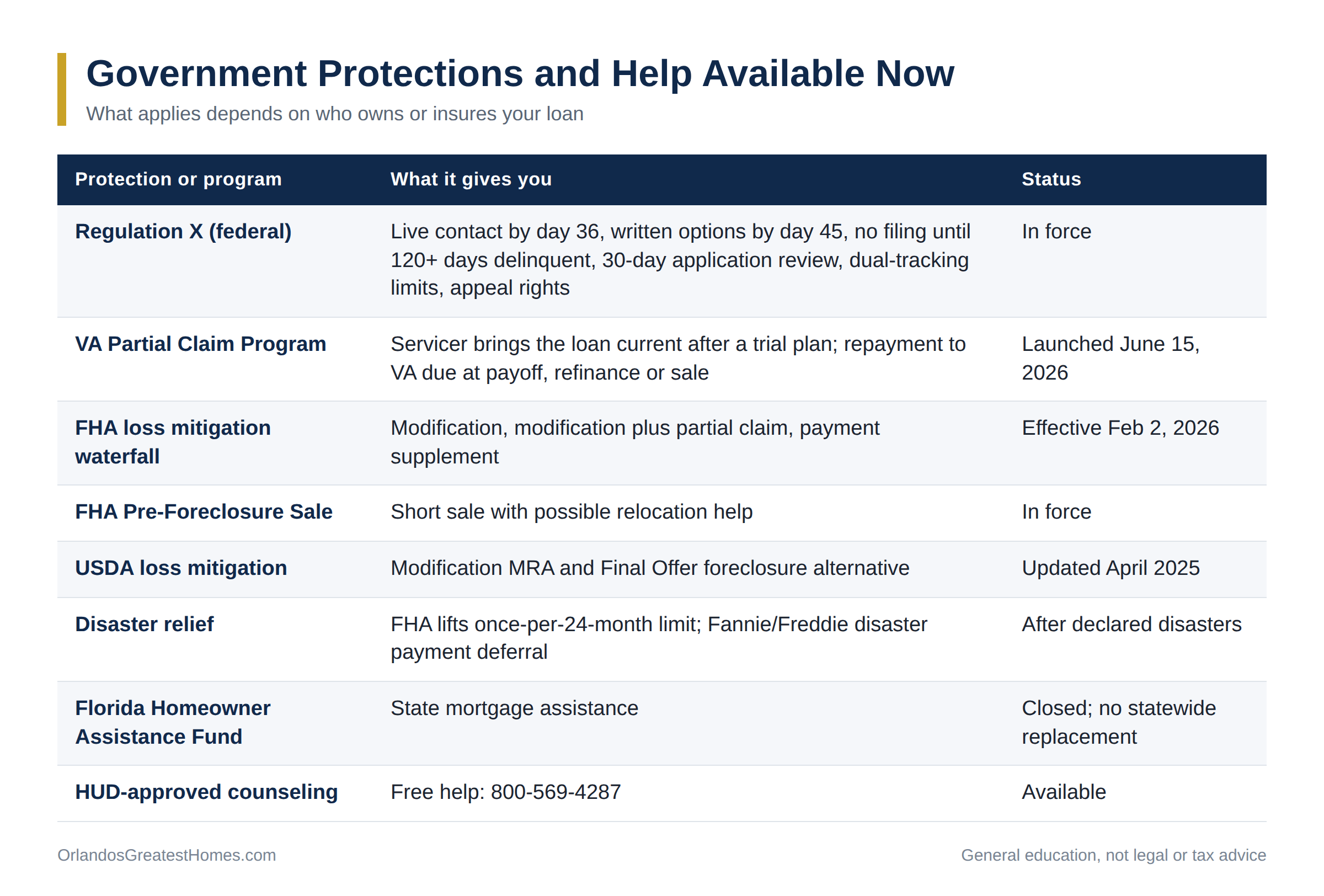
If none of these protections fit your loan, the short sale is the tool where you have the most control over the deficiency.
Timelines: First Missed Payment to Sale Day
Day counts start at the first missed payment. Florida is a judicial foreclosure state, so the lender has to sue and win a court judgment before it can sell your house (Nolo).
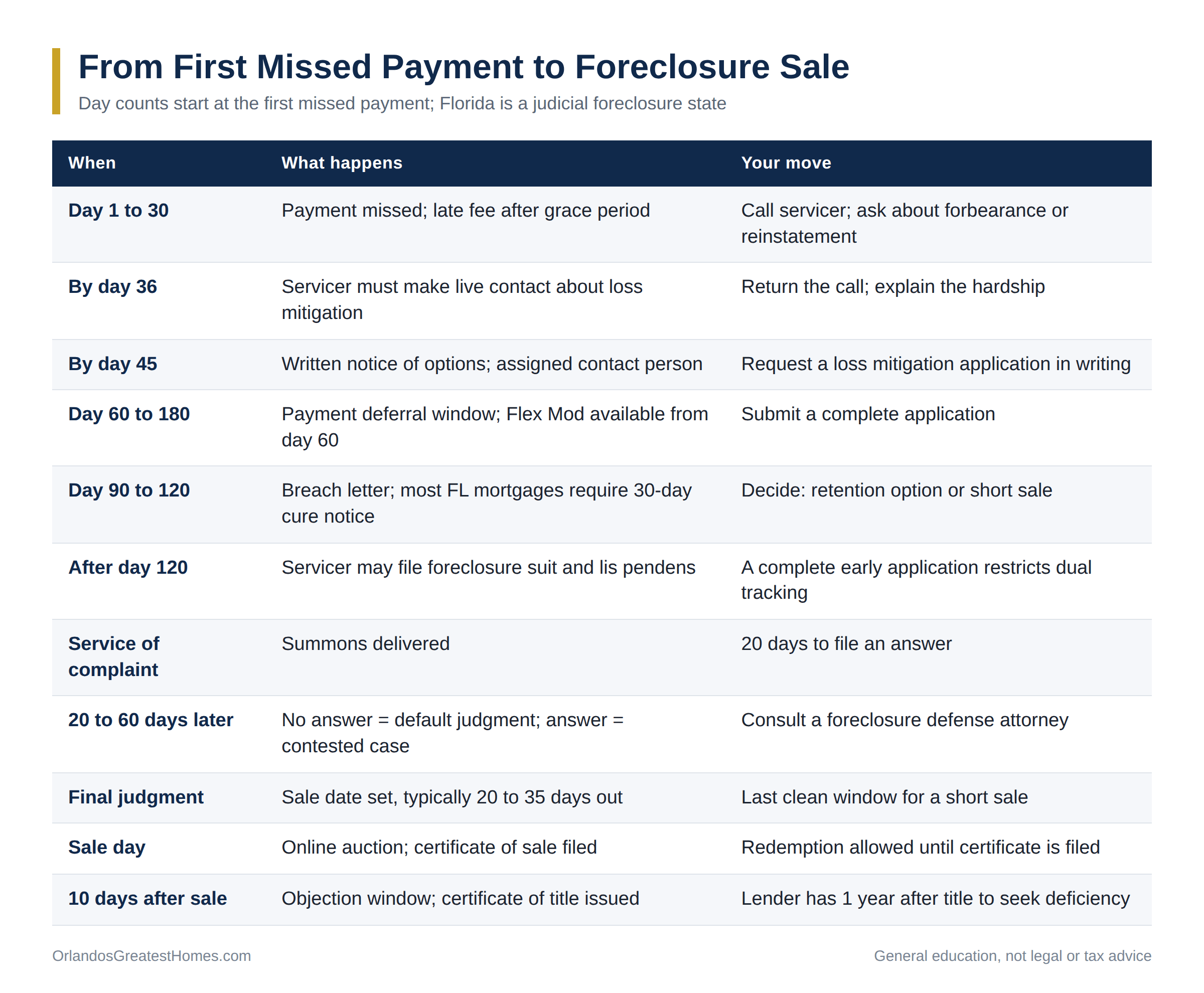
Total Florida timeline: about 7 to 11 months if uncontested and 14 to 25 months if contested. High-volume counties, including Orange, often run 14 to 24 months even when uncontested (Florida Foreclosure Help, 2026). Actual time depends on the judge and the docket.
While your application is under review:
• 5 business days: servicer acknowledges it and lists missing documents.
• 30 days: servicer evaluates a complete application submitted more than 37 days before a sale.
• 37 days before sale: the cutoff for most protections.
• 90 days before sale: submit by then and a modification denial can generally be appealed.
• Dual tracking: the servicer generally cannot push the foreclosure while a timely, complete application is pending.
The exact rule text is in 12 CFR 1024.41. These are the general rules; confirm details against your file.
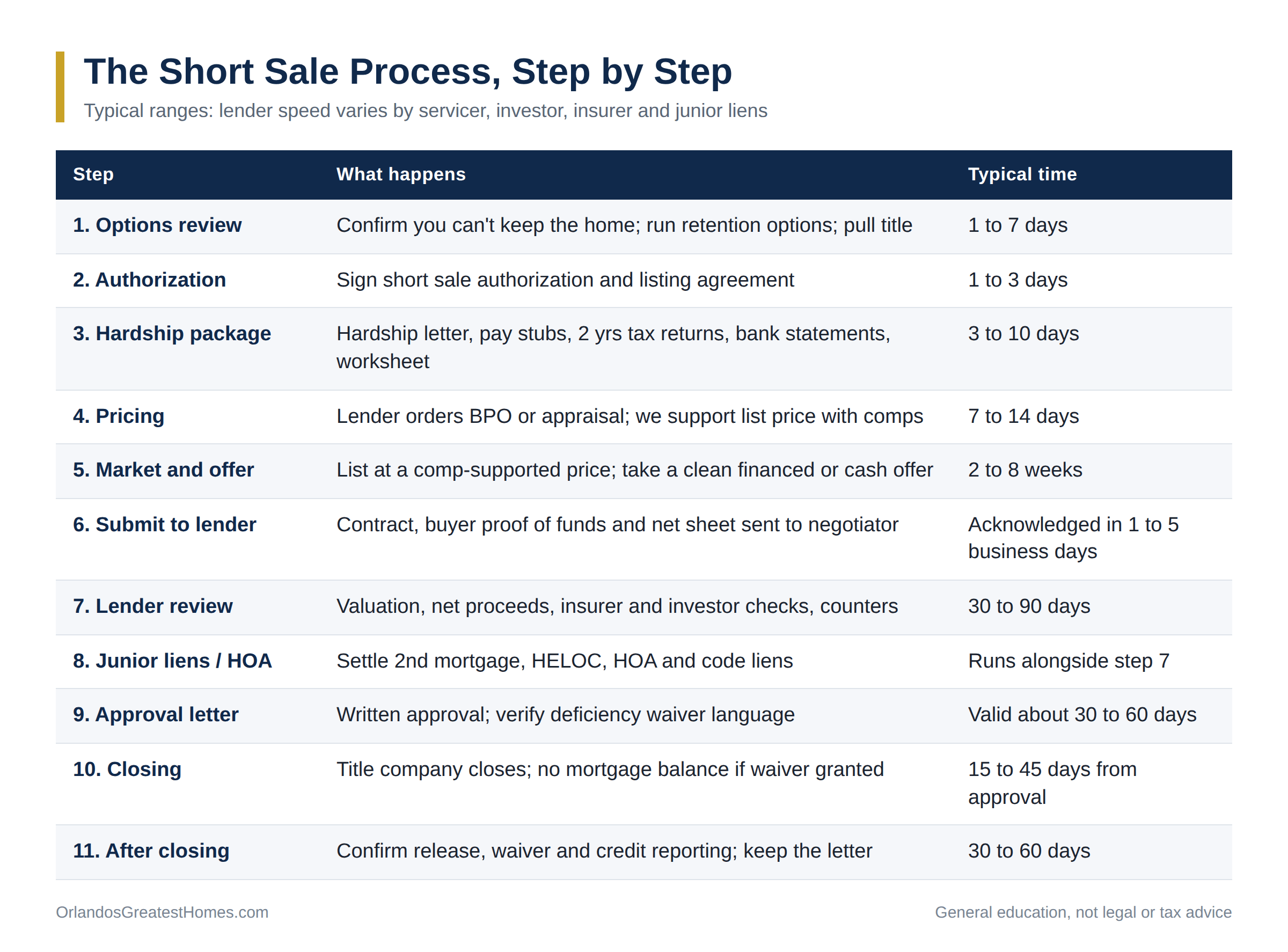
The Short Sale Process, Step by Step
These are typical ranges, not guarantees, based on my experience. Speed depends on the servicer, the investor, whether a mortgage insurer is involved, and how many junior liens exist. A clean Fannie/Freddie file with a complete package moves faster than one with a second mortgage and an HOA lien.
What kills a short sale:
• No authorized negotiator on your side, or calls routed to the wrong department.
• Incomplete packages. Expired pay stubs and missing pages restart the clock.
• Weak offers. Shaky financing or a long closing can let the approval expire.
• A sale date on the calendar. Get a contract in place before the final judgment.
• Surprise liens: second mortgages, HOA, code enforcement, tax liens, unpaid utilities.
Gather on day one: hardship letter, last 2 pay stubs (or 12 months of profit and loss if self-employed), 2 years of tax returns and W-2s or 1099s, 2 to 3 months of full bank statements, government ID, current mortgage statement, and HOA contact information.
Why the Lender Says Yes
A lender approves a short sale when it nets more than it would from foreclosure and reselling the house. It is not doing you a favor. It is avoiding the bigger loss.
What the lender takes on if it takes the house back:
• Attorney fees and court costs, plus months or years of delay while interest, taxes, and insurance keep accruing.
• Securing the property: lockbox, lawn, winterizing, board-up, code citations, HOA dues, utilities.
• Vandalism, theft, and deterioration. Until it has title and possession, the lender has no control over condition.
• Insurance and taxes on a vacant property, including hurricane risk in Florida.
• Repairs, commission, closing costs, and months of holding time to resell.
• A resale price that is often lower than a normal sale because of condition and the forced-sale discount.
The risk: once the bank owns it, it has to secure it, insure it, maintain it, repair it, list it, and hope the market pays more than the short sale price. If the house sits, values slip, or a storm hits, the loss grows. A short sale replaces all of that with a buyer in place, a price the market has tested, and a closing in weeks.
Here is an example with made-up numbers:
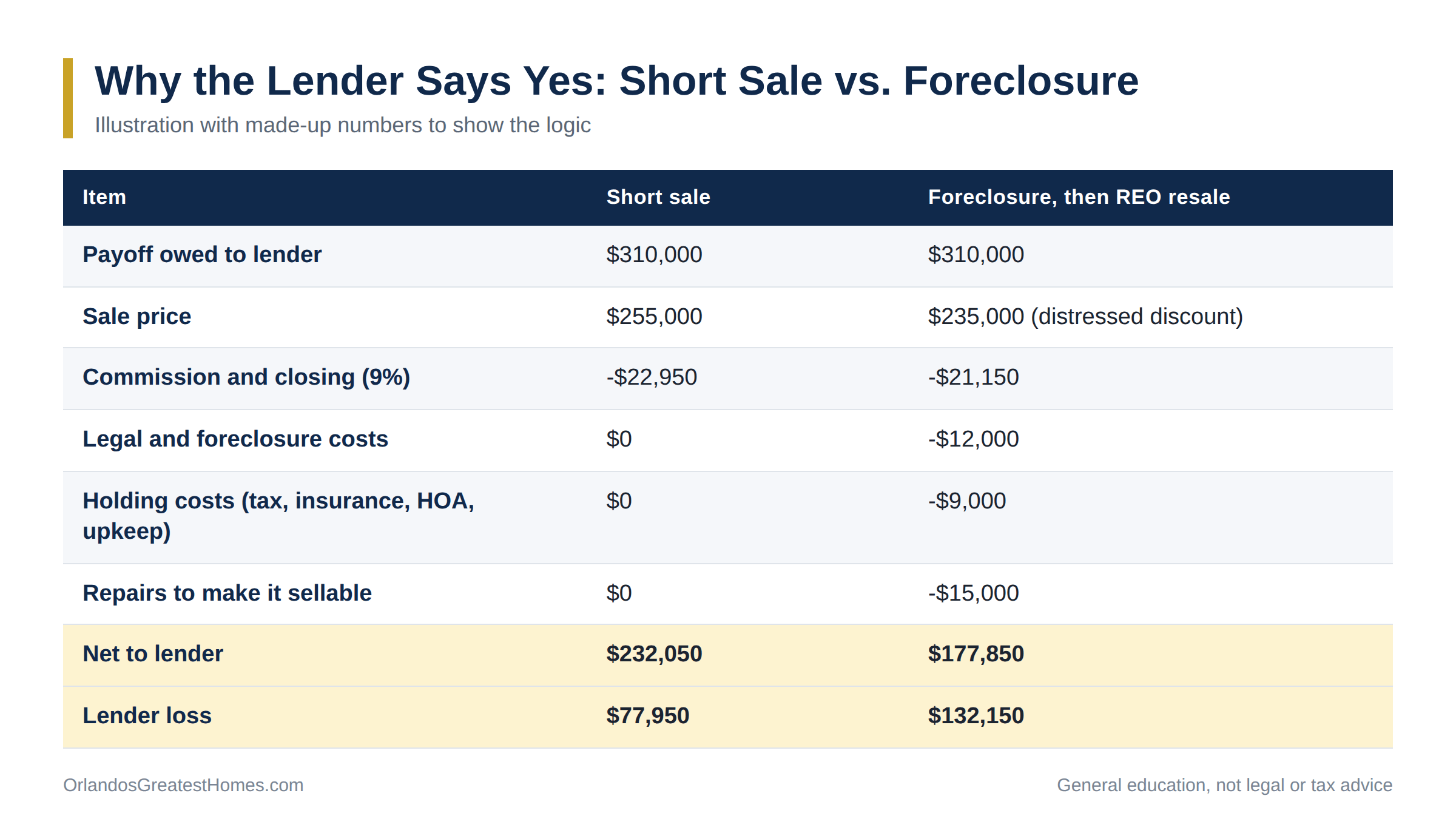
Same house, same payoff. The lender loses about $54,000 less on the short sale, and that gap is your negotiating leverage. Real numbers vary by property and county.
Fannie Mae and FHA both run formal short sale programs for this reason. Fannie’s fact sheet notes borrowers may qualify for another Fannie Mae mortgage “in as little as 2 years” after a short sale versus “up to 7 years” after a foreclosure (Fannie Mae).
Deficiency Waivers: Negotiate Up Front or Gamble After
The deficiency is the gap between what you owe and what the house brings. In a short sale it is on the table before closing. In a foreclosure it is a claim the lender can pursue after the sale, and you wait to see whether it does.
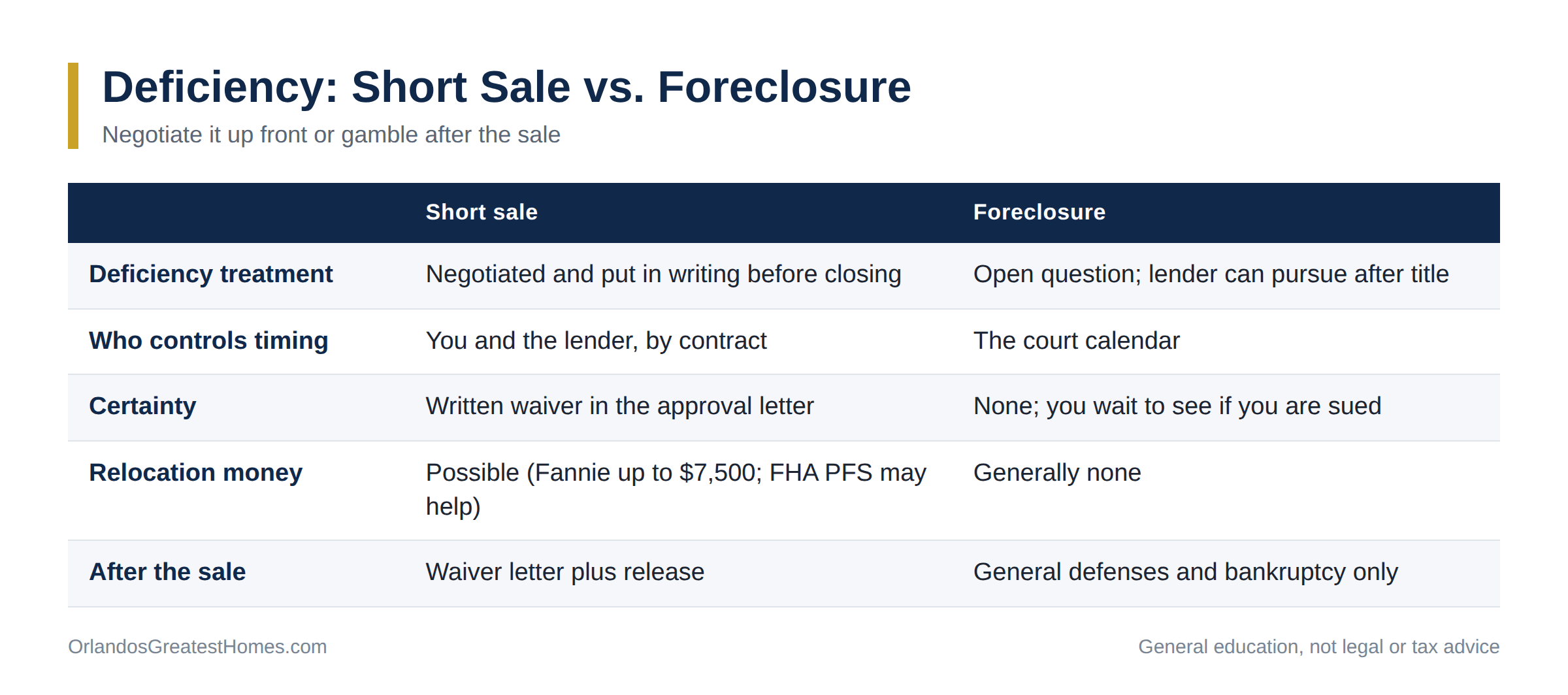
Short sale: the approval letter states how the shortfall is treated. The goal is a full written release. Fannie Mae’s fact sheet says borrowers receive a “deficiency waiver” on completion, though tax consequences may apply (Fannie Mae). Some lenders ask for a cash contribution or promissory note. That is a negotiating position, not a rule.
Foreclosure in Florida: the lender can seek a deficiency judgment within one year of the certificate of title, and for an owner-occupied home the amount is limited to the difference between the judgment and fair market value. Nolo also notes a five-year window for filing foreclosure actions (Nolo). Whether the lender pursues it depends on the investor, the size of the shortfall, your assets, and the cost of collecting. Bankruptcy can eliminate it at its own credit cost.
Get these four things in writing:
1. The lender accepts the sale proceeds as full satisfaction of the debt.
2. A waiver of any deficiency, including any claim by the mortgage insurer or investor.
3. Confirmation of how the loan will be reported and whether a 1099-C will follow.
4. Confirmation that junior liens are released or separately resolved.
If no government protection fits your loan, the short sale is where you have the most leverage to eliminate the deficiency. After the foreclosure sale, most of that leverage is gone.
Credit Impact and Waiting Periods
Both hurt your score. Nolo reports a foreclosure “tends to lower your scores by at least 100 points or so,” with a 680 score losing about 85 to 105 points and a 780 score losing 140 to 160, and says there is not a huge difference in the score drop between a foreclosure and a short sale (Nolo). The real difference is how long you wait to buy again.
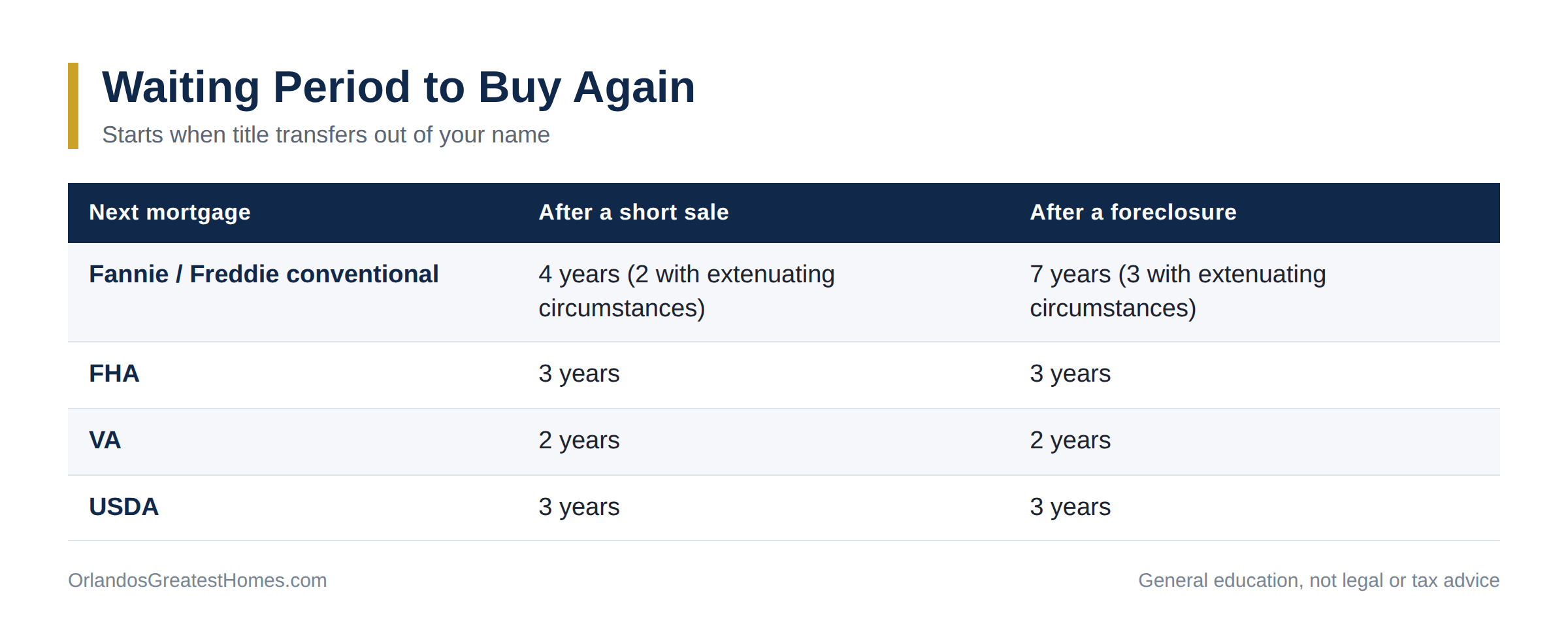
Source: waiting-period summary. The clock starts when title leaves your name, not when you missed your first payment. Lenders can add their own overlays, so confirm before you plan a purchase.
• Late payments before the sale already cut your score, so the final event often adds less damage than people expect.
• A loan modification usually does less harm than either a short sale or a foreclosure, depending on how the servicer reports it.
• A foreclosure is a public court record. A short sale is a private transaction.
• Some employers, landlords, and security-clearance reviewers may look harder at a foreclosure than at a negotiated sale.
Taxes, Liens, and Hidden Costs
Forgiven mortgage debt can be taxable income, so the deficiency waiver has a tax side. The federal exclusion for forgiven principal-residence debt (up to $750,000) was written to run through December 31, 2025 (NAR). A bill to restore it, the Mortgage Debt Tax Forgiveness Act of 2025 (H.R. 917), was introduced, and I could not confirm it has been enacted. Have a CPA check current law before any 2026 closing.
Two exclusions do not depend on that law: insolvency (your debts exceed your assets just before the discharge, up to the amount of insolvency) and bankruptcy. Many homeowners facing a short sale are insolvent on paper, which is why IRS Form 982 matters.
• A 1099-C may arrive after the waiver. Report it with the insolvency exclusion if it applies. Do not ignore it.
• Junior liens. A waiver from the first lender does not release a second mortgage, HELOC, HOA, or code lien. Each needs its own release.
• Cash contribution or promissory note requests. Weigh them against the cost of a foreclosure.
• Relocation help. Fannie Mae may pay up to $7,500 in some short sales, and FHA’s program may also help.
• HOA and condo liens. Unpaid assessments can follow the unit, so order an estoppel letter early.
• Foreclosure rescue scams. Upfront fees, deed transfers, and guaranteed saves are red flags. HUD-approved counselors are free (800-569-4287).
Why Avoid Foreclosure, and What I Do
Foreclosure is the outcome you control least. The court sets the calendar, the lender controls the sale, and the deficiency question stays open afterward. Every option earlier in the process gives you more control, more time, and better terms. Ignoring the notices is the worst move: miss the 37-day window and you give up most of the federal protections.
The order of attack:
1. Keep the house if you can afford the payment again. Reinstatement, repayment plan, payment deferral, modification, or partial claim.
2. If you can’t afford it, sell before the judgment. A short sale, or a regular sale if there is equity.
3. If the house has to go back, a deed in lieu is an option where title is clean.
4. Foreclosure is the last resort, not a strategy.
I have 23+ years in Florida real estate, 500+ homes sold, 200+ flips, and 400+ short sales completed with deficiency waivers secured. I work tax deeds, foreclosures, probate, liens, and HOA negotiations. On a file like yours I:
• Identify the loan owner and any insurer, then go past the front-line servicer to the people who can approve the deal.
• Run every retention option first, so you know a short sale is the right call and not just the easy one.
• Build the package, price the property, line up a financed or cash buyer, and handle junior liens and HOA.
• Negotiate the deficiency waiver up front and confirm it in writing before closing.
• Track every date, approval, and deadline so nothing expires.
If you are already in the lis pendens or judgment stage, time is tight. A short sale can still work when a contract is in place before the sale date.
Your Checklist
• Call the servicer, ask for loss mitigation by name, and request a written application and the name of the loan investor.
• Submit a complete package now, and more than 37 days before any sale date (90 days to keep appeal rights).
• Ask in writing whether you qualify for forbearance, a repayment plan, payment deferral, a modification, or a partial claim.
• If the loan is VA, ask specifically about the VA Partial Claim Program.
• If the answer is no or the payment isn’t affordable, authorize a short sale agent and start the package.
• Pull title and list every lien: second mortgage, HELOC, HOA, code, tax, judgment.
• Get any approval letter, with the deficiency waiver, in writing before closing.
• Talk to a CPA about Form 1099-C and the insolvency exclusion.
• Never pay an upfront fee to a “foreclosure rescue” company or sign over your deed.
The short sale step timelines and the lender-loss example are my estimates for explanation, not from the linked sources. This is general education, not legal or tax advice. Rules and program terms change, and loan-specific facts decide the outcome. Confirm with your servicer, a Florida attorney, and a CPA.
Connect With Me
Yogi Ganeshram | Real Estate Agent, eXp Realty LLC
Phone: (321) 217-4220
Email: yogi@orlandosgreatesthomes.com
Website: EquityEdgeOrlando.com,
https://orlandosgreatesthomes.com
Instagram: @yogisequityedge
TikTok: @yogisequityedge
Facebook: facebook.com/yganeshram
LinkedIn: linkedin.com/in/yganeshram
YouTube: @YogisEquityEdge
Pinterest: @yoganeshram