

Original conceptual illustration. Not a photograph of an actual transaction.
The market is changing
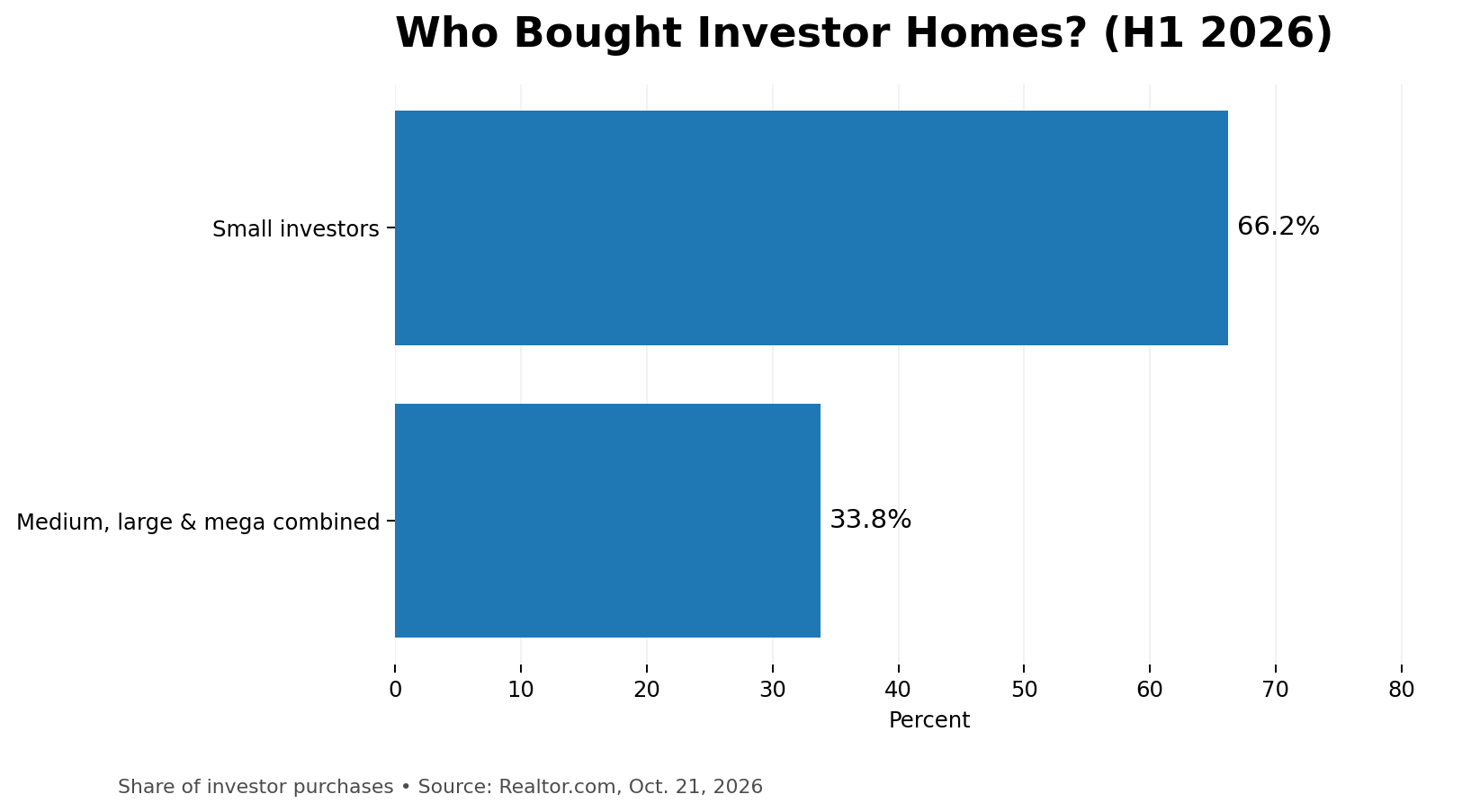
For years, much of the conversation about investor competition focused on institutional buyers. But Realtor.com’s October 21, 2026 Investor Report shows a change in the mix: small investors accounted for 66.2% of investor purchases in the first six months of 2026, the largest share in at least 15 years. Large and mega investors, by contrast, sold more homes than they bought.
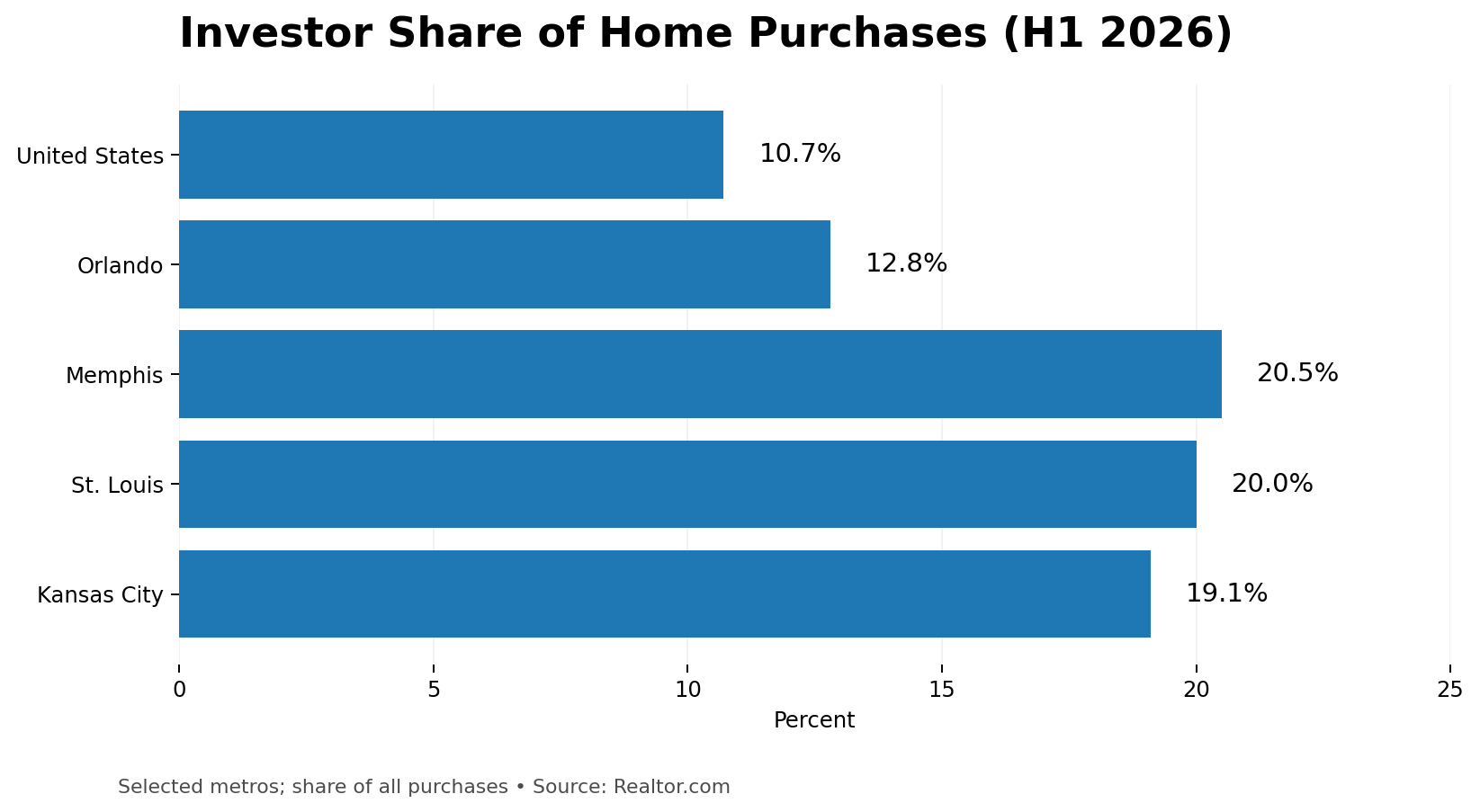
This does not mean small investors bought two-thirds of all homes: all investors together accounted for 10.7% of home purchases.
What the national data actually says
Investors purchased about 224,000 homes in H1 2026, down 7.0% year over year and the lowest first-half level since 2020. Investors also sold approximately 196,000 homes. Investor sales accounted for 9.4% of overall sales.
The typical investor purchase price was $295,000, versus $380,000 for non-investor buyers. Price differences may reflect property types, local markets, or condition, and should not be interpreted as proof that every investor bought below market value.
Who counts as small?
Realtor.com defines small investors as entities with 1–10 cumulative purchases, medium 11–50, large 51–350 and mega 351 or more. Its methodology relies on deed transactions and corporate/entity ownership, so individual landlords who buy under personal names may be omitted. A growing share for small investors also does not establish that their absolute purchase count rose.
Why large investors are retreating
The report documents a pullback beginning as borrowing costs rose, rent growth cooled, and price appreciation softened after 2022. Institutional investors must consider portfolio-level financing, management, maintenance, and risk.
A hypothetical $250,000 loan at 4% over 30 years costs approximately $1,194 a month in principal and interest; at 7%, it costs approximately $1,663. That $469 monthly difference is material when repeated across many properties.
Selling can reflect capital allocation rather than distress. Reported policy uncertainty may also have played a role, but the data alone cannot establish motive for each transaction.
Why small investors still participate
An individual investor can evaluate one specific opportunity rather than meet a broad acquisition target. Some may tackle properties that require individualized renovation and title due diligence.
Still, smaller scale does not eliminate risks: taxes, insurance, unexpected repairs, vacancy, contractor delays and financing all affect returns. Local knowledge is useful only if reflected in sound estimates and disciplined pricing.
Cash remains important
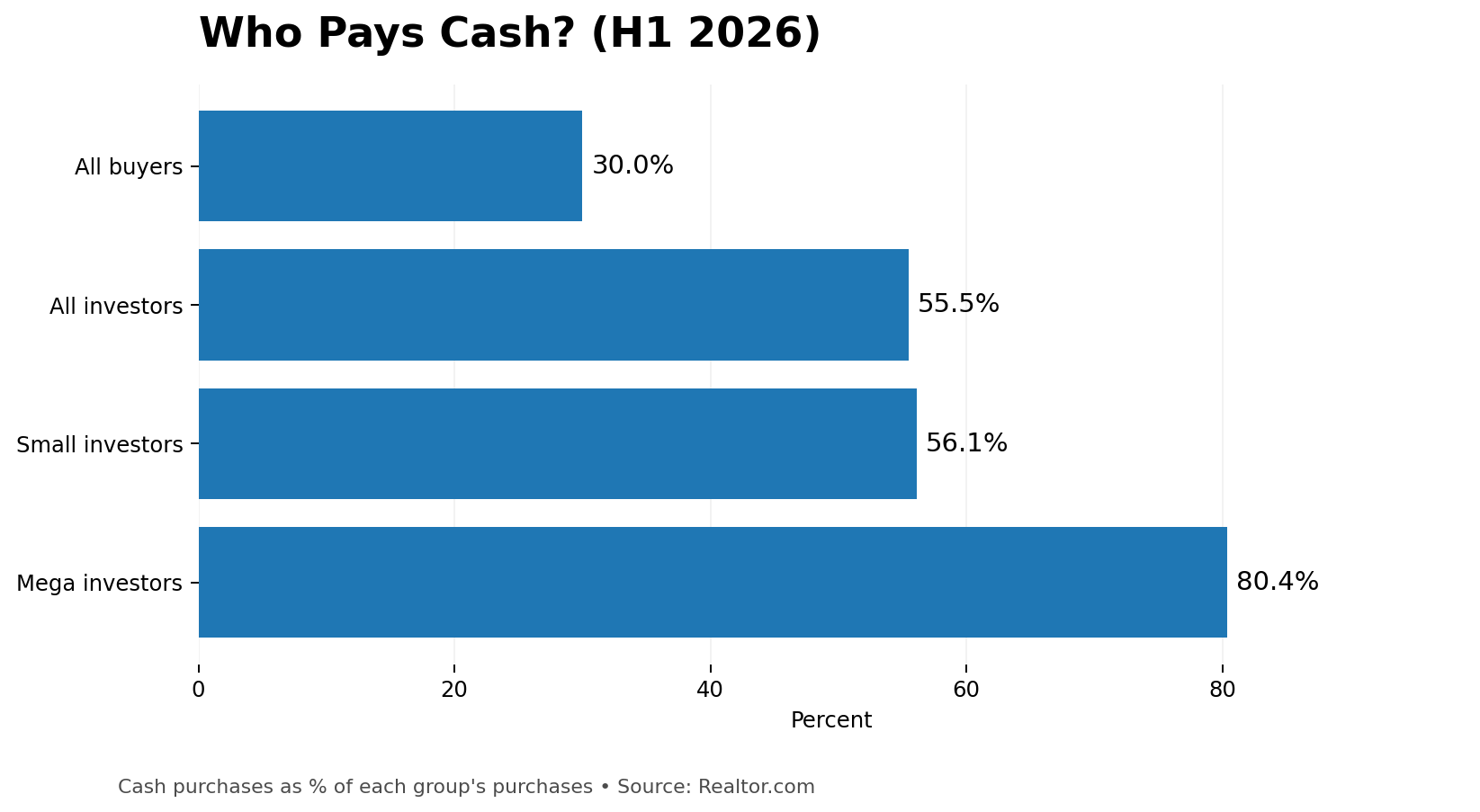
Realtor.com found 55.5% of investor purchases in the first half were all-cash versus 30.0% marketwide. Within the investor cohorts, 56.1% of small-investor purchases and 80.4% of mega-investor purchases were cash.
Cash can make closing simpler, but carries opportunity costs and liquidity constraints.
Orlando: higher investor participation than the U.S. overall
The Orlando–Kissimmee–Sanford area recorded 2,588 investor purchases, or 12.8% of home purchases, compared with 10.7% nationally. The median reported Orlando investor acquisition price was $372,195. That is a metro-wide figure, not a prediction for a specific neighborhood.
In Florida, evaluate insurance, taxes following transfer, repair scope, achievable rent, code and title issues, and potential resale costs before deciding on any deal.
A hypothetical rental: what the return really looks like
Assume a property purchased for $200,000 requires $45,000 of renovations and $10,000 in closing and initial carrying costs: $255,000 total capital. Annual scheduled rent at $2,000 per month is $24,000.
If operating expenses including vacancy, maintenance, property tax, insurance, management and capital reserves total $11,320, estimated annual income after those allowances is $12,680, or about 5.0% of invested capital before financing and income taxes.
If expenses instead run $8,000, the indicated yield rises to roughly 6.3%; if $14,000, it falls to roughly 3.9%. These are illustrative assumptions, not actual market quotes. They exclude extraordinary costs and changes in property value.
What this means for buyers and sellers
For traditional buyers, institutional pullback does not eliminate competition for affordable homes. Compare individual listing prices to recent comparable sales, inspect condition, and understand the total monthly cost.
For sellers, investor offers may provide flexibility and as-is terms, but a wider traditional marketing strategy may yield different net proceeds. Compare estimated proceeds after fees, repairs and timing risks before deciding.
My takeaway
The headline is striking, but market share and profitability are not the same thing. Larger investors are buying less; smaller investors now constitute a bigger portion of the remaining acquisitions.
Before you buy, confirm value, renovations, carrying costs, financing, achievable rents or resale price and the downside scenario. If the margin of safety is inadequate, walking away protects capital.
Your turn
Are smaller investors finding opportunities that institutional buyers overlook, or are large investors recognizing risks others may be underpricing? Share what you are seeing in your market.
About Yogi’s Equity Edge
I’m Yogi Ganeshram, a Central Florida real estate professional with eXp Realty and more than 23 years of experience, including 500+ homes sold, 200+ flips and extensive distressed-property and short-sale work. I work with traditional homebuyers and sellers as well as real estate investors.
Investment education: Equity Edge Orlando
Buying or selling: Orlando’s Greatest Homes
Sources and assumptions
Primary source: Hannah Jones, Realtor.com H1 2026 Investor Report, October 21, 2026.
Realtor.com uses deed-based entity transactions recorded through June 2026 and covers the 100 largest metro areas by household count. Comparisons refer to that dataset, not necessarily every private individual investor.
Mortgage and underwriting examples use explicitly hypothetical assumptions. Educational information, not investment, legal or tax advice.