
Most homeowners facing missed payments think they only have two choices: catch up or lose the house. That’s wrong, and believing it is what pushes people into foreclosure who didn’t have to end up there. On the investor side, tax deeds and foreclosure auctions get sold as easy money — buy a property for a fraction of value, flip it, done. Also wrong, and it’s why so many first-time buyers at both types of auctions lose money on their first purchase.
This is the long version — every homeowner option in one place, the full Florida foreclosure timeline, the real difference between a tax lien and a tax deed, and exactly where investors get hurt on both sides.
Every Option a Homeowner Facing Foreclosure Actually Has
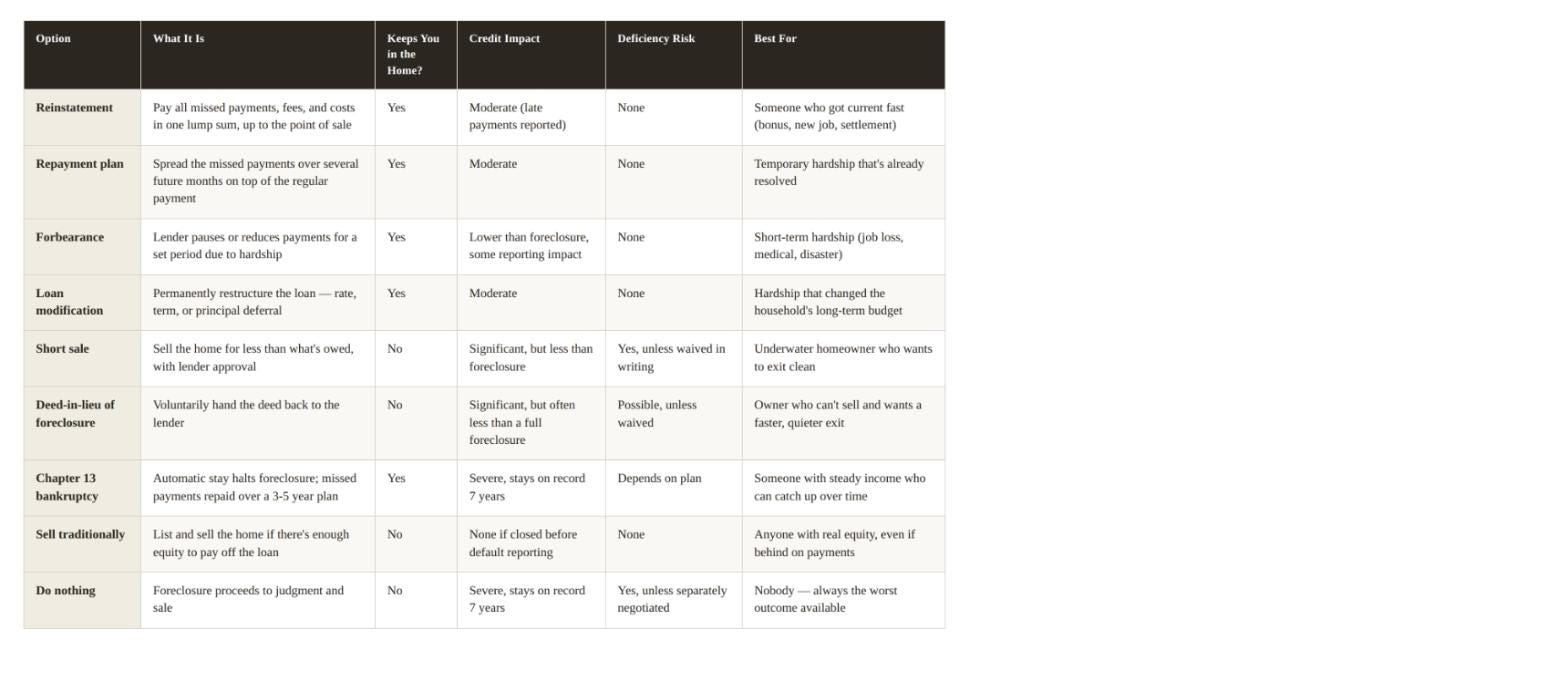
A missed payment doesn’t automatically mean foreclosure. Depending on how far behind you are, how much equity you have, and whether the hardship is temporary or permanent, there are at least nine different paths — and picking the wrong one costs people thousands of dollars and years of credit damage they didn’t need to take on.
— here’s every stage:
Day 1: Missed payment. Most loan servicers don’t act immediately. A single missed payment doesn’t trigger foreclosure by itself.
Day 30-45: Second missed payment and default letters begin. The servicer sends notices and may attempt contact, but formal action still hasn’t started.
Day 90-120: Notice of Default and acceleration. After roughly three missed payments, the lender can accelerate the loan, meaning the full balance becomes due, not just the missed payments.
Day 120+: Lawsuit filed. The lender’s attorney files a foreclosure complaint with the court and you’re served with a summons. You generally have 20 days to respond.
Months 4-10: Litigation. If you don’t respond, the lender can move for a default judgment relatively quickly. If you do respond — especially with an attorney — this stage can stretch for many months through motions, mediation, and scheduling.
Final judgment: The court enters a final judgment of foreclosure stating the amount owed and scheduling a sale date, typically 20-35 days out.
Sale date: The clerk of court holds a public auction, usually online in most Florida counties today. The highest bidder gets a certificate of sale.
10 days after the sale: Objections to the sale must be filed within this window. If none are filed, the certificate of title issues and the former owner’s redemption rights end.
Total uncontested timeline: roughly 8-14 months from the first missed payment to a completed sale. Contested cases with an attorney can run 18-24+ months.
The single most important thing in this entire timeline: the earlier a homeowner acts, the more of the nine options above are still on the table. By the time a final judgment is entered, reinstatement, forbearance, and loan modification are usually off the table — a short sale or deed-in-lieu may still be possible right up until the sale date, but the options narrow every month that passes.
Tax Lien vs. Tax Deed: The Difference Nobody Explains Clearly
These two get confused constantly, and they are fundamentally different investments with different risk profiles, different timelines, and different paths to actually owning real estate.
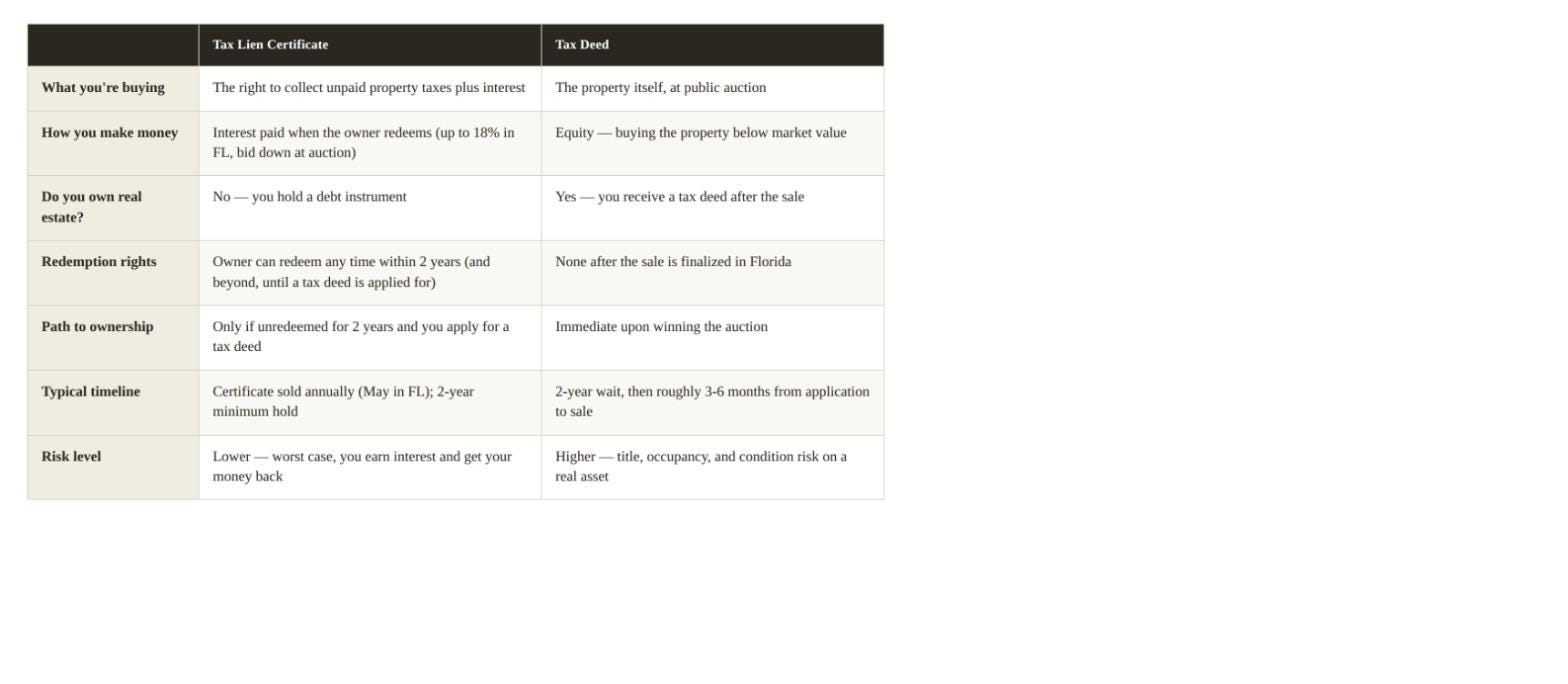
The short version: a tax lien certificate is a debt instrument — you’re paying someone else’s back property taxes and collecting interest (up to 18% in Florida) when they eventually pay it off. You don’t own anything until the certificate goes unredeemed for two years and you apply for a tax deed. A tax deed sale, on the other hand, is the county auctioning off the actual property to satisfy unpaid taxes — you’re bidding on real estate, not a debt instrument, and you own it the moment you win the auction.
How a Florida Tax Deed Sale Actually Works
Here’s the timeline from unpaid taxes to a completed tax deed sale:
Year 1: Property taxes go unpaid. The county sells a tax lien certificate to an investor at auction (Florida holds these in late May).
Years 1-2: The certificate holder earns interest while the owner has the right to redeem — pay the back taxes plus interest — at any point.
After 2 years: If still unredeemed, the certificate holder can apply for a tax deed, which forces the county to schedule an actual property auction.
3-6 months after application: The county holds the tax deed sale. Anyone can bid, not just the certificate holder — though the certificate holder gets credited for what they’ve already paid in.
At the sale: Highest bidder wins and receives a tax deed. There is no redemption period after this sale is finalized — unlike a foreclosure auction, once it’s done, it’s done.
Total timeline from first unpaid tax bill to a tax deed sale: a minimum of roughly 2 years and 3-9 months, though it commonly runs longer depending on the county’s backlog.
Tax Deed Sale vs. Foreclosure Auction
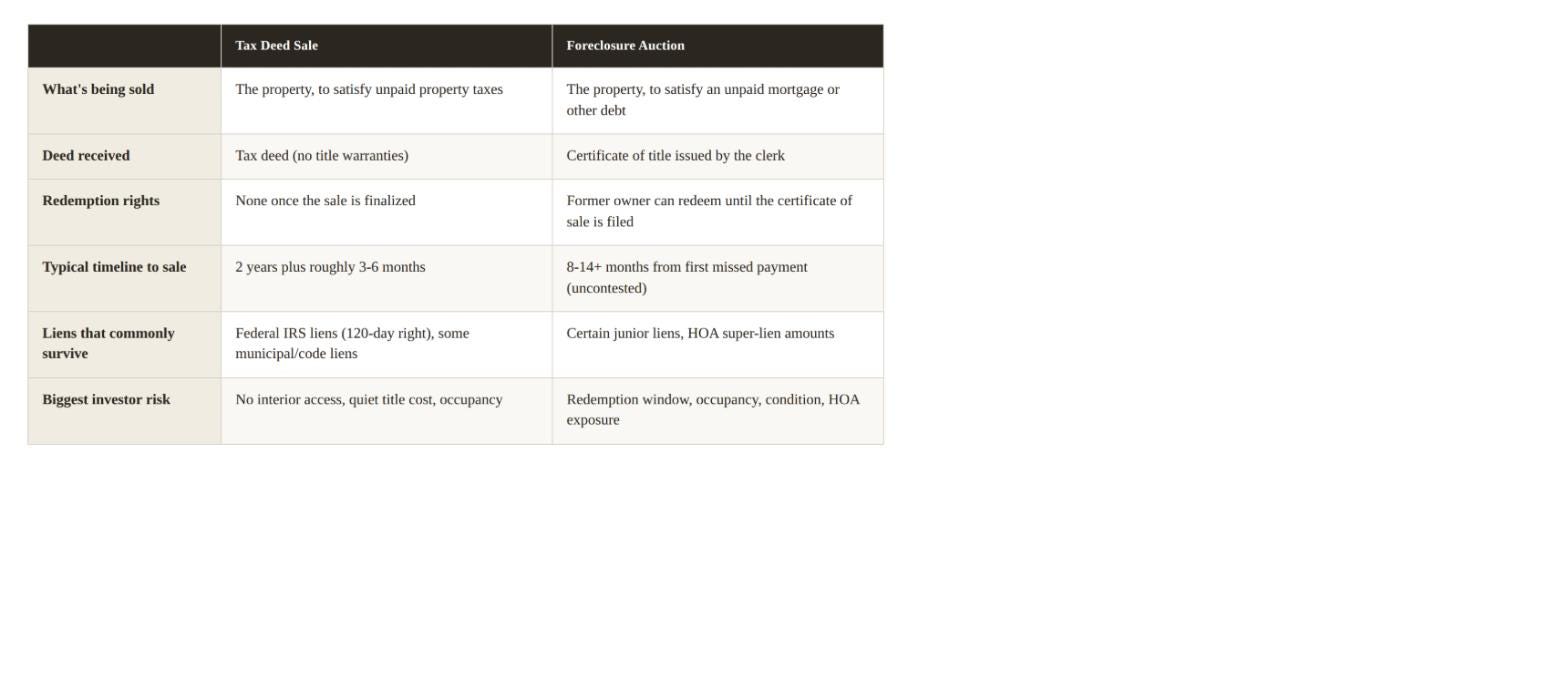
Both put a property up for public auction, but the legal mechanics — and the risks to you as the buyer — are meaningfully different:
Why Investors Lose Money Buying Foreclosure Properties
Most first-time foreclosure auction buyers lose money for one of four reasons. They bid on the outstanding loan balance instead of researching actual market value, and pay full retail for a distressed house. They skip the title search, and discover after the sale that HOA liens, junior mortgages, or code violations survive the sale and become their problem. They never see the interior — foreclosure auctions almost never allow inspections — and the $40,000 in repairs they didn’t budget for wipes out the entire spread. And they forget about the redemption period: in some cases the former owner can still redeem the property after the sale, and a buyer who’s already put money into repairs can lose the property entirely.
Why Investors Lose Money Buying Tax Deed Properties
Tax deed buyers lose money in different but equally predictable ways. They win a property with no interior access and no idea what’s actually wrong with it structurally. They don’t realize a tax deed carries no title warranties, so if that title has issues, they may need to pay for a quiet title action — often $1,500-$3,500 and 4-6 months — before they can get title insurance or sell to a retail buyer. They miss that federal IRS liens can survive a tax deed sale for 120 days after the sale. And they don’t budget for the fact that the property may still be occupied, which can mean a separate eviction process before they can even access it.
The pattern in both cases is the same: the people who lose money treat the auction like a shortcut. The people who make money treat it like what it actually is — a legal process with real deadlines, real liens, and real risks that has to be worked correctly every single time.
How to Actually Do This Without Losing Money
Before bidding on anything — foreclosure or tax deed — pull the full title history yourself or pay a title company to do a preliminary search. Know which liens survive the specific type of sale you’re bidding at. Drive the property and, where legally possible, get eyes on the exterior and talk to neighbors about its condition and occupancy. Set a maximum bid based on conservative after-repair value minus a real repair estimate minus your margin, and don’t move that number once the bidding starts. And budget separately for the paperwork side — quiet title, eviction if occupied, and holding costs while any of that gets resolved — because that’s where most of the “surprise” costs in this business actually come from.
Bottom Line
Distressed real estate — on both the homeowner side and the investor side — rewards people who understand the actual process and punishes people who skip steps because they’re in a hurry. A homeowner who knows all nine options can often avoid foreclosure entirely, even deep into the timeline. An investor who does the title work and budgets honestly can build real wealth in this space. The people who get hurt on either side are the ones who didn’t know what they didn’t know.
If you’re a homeowner trying to figure out which option fits your situation, or an investor looking to get into tax deeds, foreclosures, or short sales the right way, reach out. I’ve been doing this for 23+ years, closed 500+ homes, and completed 400+ short sales with deficiency waivers secured — happy to walk you through exactly how to do this without becoming one of the statistics above.
Connect With Me
Yogi Ganeshram — 23+ years in real estate, 500+ homes sold, 200+ flips, 400+ short sales closed with deficiency waivers secured.
Website: equityedgeorlando.com
Email: yogi@orlandosgreatesthomes.com
YouTube: search Yogi Ganeshram
Disclaimer: This article is for educational purposes only and is not legal, tax, or financial advice. Foreclosure and tax deed laws vary by state and change over time — the timelines and processes described here reflect general Florida procedure and may not apply to your situation or jurisdiction. Consult a licensed attorney, CPA, or housing counselor before making decisions about a specific property or financial hardship.