
Buying the Property Was the Easy Part
Once your self-directed IRA owns a cash-flowing rental, the real wealth-building decision starts: what do you do with the $1,800-$2,000 hitting the account every month? Most people let it sit in cash inside the IRA “waiting for the next deal.” That’s the single biggest mistake I see once this strategy starts working.
Two Growth Engines, Not One
Once you own real estate inside a self-directed IRA, you actually have two things growing at the same time.
The property itself appreciates — slowly, averaging something like 3% a year over the long run, roughly in line with inflation. A $220,000 property appreciating at 3% a year is worth roughly $534,000 in 30 years. That’s the property doing what it does, with no extra effort from you.
The bigger lever is the second engine: what happens to the $1,800-$2,000 a month landing in the IRA every single month for the next 30 years.
Why That Money Should Never Sit in Cash
Every dollar of net rental income inside a self-directed IRA is money you already keep 100% of — no tax bill this year, nothing to report, nothing due until you eventually take distributions in retirement. Leaving it parked as idle cash in the custodian account wastes the single biggest advantage of the account: decades of tax-deferred compounding.
Instead, that monthly income should get redeployed the same month it lands — into liquid, income-producing or growth assets, still inside the IRA, still fully tax-deferred.
Three Ways to Redeploy It
Broad market index fund. An S&P 500 index fund has averaged close to 10% a year including dividends over the long run — not every year, some years are down 20%+, some are up 30%+, but the long-run average lands around there. Simplest, lowest-cost option, zero ongoing management.
Covered call ETFs. These sell call options against a stock or index position and pay the premium out as monthly income — some yield 8-12%+ annually in distributions. The tradeoff: covered call funds cap your upside in strong bull markets, since you give away gains above the strike price in exchange for the premium. Total return over a full market cycle has historically trailed a plain index fund in many stretches, even though the monthly cash yield is higher. Good fit if you specifically want more current income compounding faster, not necessarily the highest total return.
Dividend growth ETFs. These hold companies with a long history of raising dividends. Total return has historically landed somewhere between covered call funds and a plain index fund — lower yield than covered calls, more upside participation, generally less volatile than a pure growth index.
None of these is universally “best.” They trade off current income, volatility, and long-run growth differently. Plenty of investors blend two or three of them inside the same IRA.
The Math: What $1,800-$2,000 a Month Actually Turns Into
Assuming a blended 10% average annual return — a reasonable long-run assumption for a portfolio weighted toward index funds and dividend growth — here’s what reinvesting every month for 30 years looks like:
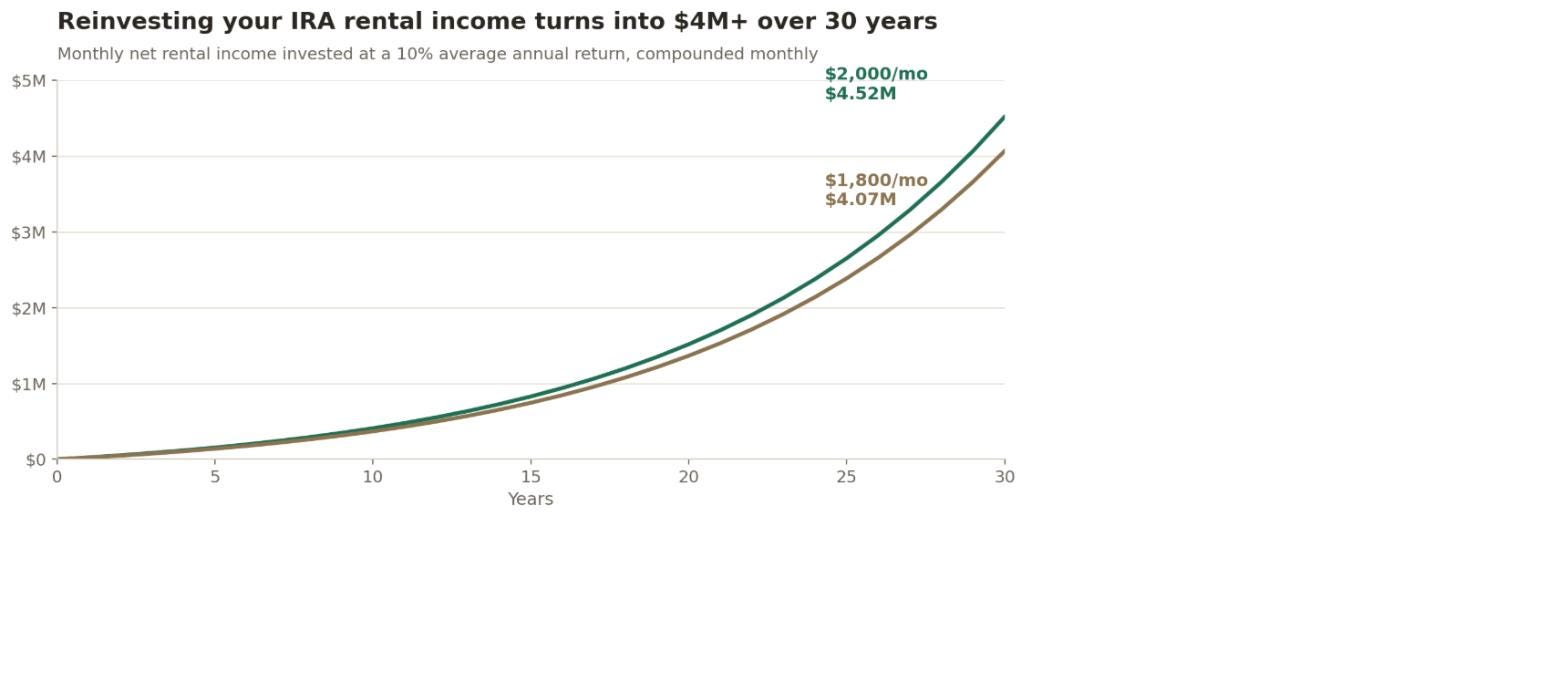
$1,800 a month invested at a 10% average annual return becomes roughly $4.07 million in 30 years. $2,000 a month becomes roughly $4.52 million — before counting a dime of property appreciation.
Stack that next to the property itself growing from $220,000 to roughly $534,000 over the same 30 years, and the account isn’t just holding one rental anymore. It’s holding a paid-off property worth half a million dollars and a liquid portfolio worth four to four-and-a-half million dollars, still compounding tax-deferred.
Honest Caveats
10% is a long-run average, not a promise. Real returns arrive in a bumpy, random order — a bad five-year stretch early on hurts a lot more than the same bad stretch in year 25. Don’t plan your retirement date around a straight-line chart.
Covered call ETFs typically carry 0.35%-0.95% expense ratios. That’s a real drag against the 8-12% headline distribution yield, so look at the fund’s net total return, not just the monthly payout number.
Everything here has to run through your self-directed IRA custodian. Buying and selling ETFs or index funds inside the same account that owns the property means checking what your custodian allows, what they charge per trade, and how fast trades actually settle.
This is not personalized financial or tax advice. Run your own numbers with your custodian and a CPA who actually understands self-directed retirement accounts before you commit new capital.
Bottom Line
Buying the property inside the IRA was step one. What you do with the rent check every month is step two — and it’s the step most investors skip. Let the income sit in cash and you’re leaving the second growth engine parked in neutral. Redeploy it every month into index funds, covered call ETFs, or dividend growth ETFs, and the same $1,800-$2,000 a month that used to feel like “just cash flow” turns into a seven-figure account on top of a paid-off property — without you ever touching the checkbook yourself.
If you already own real estate inside a self-directed IRA and want a second set of eyes on how you’re deploying the income, or you’re still working on getting your first deal into one, reach out. I’ve been doing this for 23+ years and can walk you through exactly how to set it up.
Connect With Me
Yogi Ganeshram — 23+ years in real estate, 500+ homes sold, 200+ flips, 400+ short sales closed with deficiency waivers secured.
Website: equityedgeorlando.com
Email: yogi@orlandosgreatesthomes.com
YouTube: search Yogi Ganeshram
Disclaimer: This article is for educational purposes only and is not personalized financial, investment, tax, or legal advice. Real estate and investment strategies involve risk, including the risk of loss. Past performance and projected returns (including the 10% average return used above) are not guaranteed. Consult a licensed financial advisor, CPA, or attorney before making investment decisions.